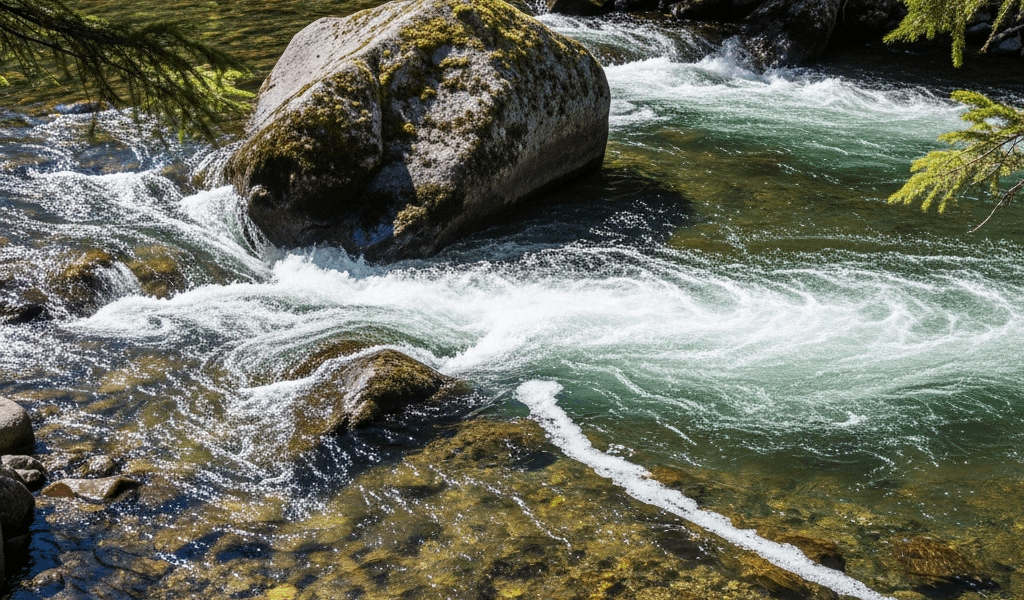
You are standing at the edge of a river watching the current push downstream, and every spot looks exactly like every other spot. The trout or bass you know are in there could be anywhere. Except they are not anywhere — they are in very specific places, and the current itself tells you exactly where if you know what to look at.
How Fish Use Current: The Energy Budget
Every fish in a river is doing constant math. They need oxygen, which comes from moving water. They need food, which drifts through faster current. But they cannot afford to burn all their calories fighting strong flow just to eat.
The solution fish have worked out over a few million years: hold in slow water right next to fast water. They sit in the calm lane, facing upstream, waiting for food to drift past in the express lane. Oxygenated water delivery plus a resting position. This one principle — the energy budget — predicts where fish hold in any river you have never fished before. Seams, eddies, structure transitions — they all create the same thing: slow water next to fast water.
Reading Seams: The Most Productive Current Feature
A seam is where fast water and slow water meet. That boundary line is the single most productive feature in any river. Fish face upstream along this edge, holding on the slow side, picking off food tumbling through the faster lane.
How to see seams: look for the line where riffled, choppy water meets flat, smooth water. Watch for color transitions — darker water means depth, lighter means shoal. Foam lines that track downstream mark current boundaries perfectly. The best seams run parallel to structure — a boulder creating a calm pocket, a log deflecting flow, a bridge piling splitting the current. Fish the edge of the seam itself, not the middle of the fast water and not the dead center of the slow water. The edge is where the food moves and the holding water sits.
I spent my first two seasons casting into the fastest current because it looked fishy. Caught almost nothing. The day I started dropping my fly right on the foam line where fast met slow, everything changed. Same river, same stretch, completely different results.
Eddies: Where Current Reverses Behind Obstacles
When water hits a large boulder, bridge piling, or sharp bend, an eddy forms on the downstream side. The current actually reverses — it circles backward, flowing upstream in a pocket right behind the obstruction. Baitfish, insects, and food debris get trapped in this circular current and concentrate. Predators follow.
The prime holding spot is the pocket between the obstruction and the eddy — the calm water right in the shadow of the boulder or piling. The challenge is presentation. When the current runs backward, your lure or fly drifts unnaturally if your line crosses the main fast-water flow. The fix: approach from the side. Position yourself so your line stays within the eddy’s circular flow rather than cutting across the fast-water boundary. Side-casting parallel to the obstruction and letting the eddy carry your presentation naturally gets far more strikes than fighting the cross-current drag.
Riffles, Runs, and Pools: Reading the Three Zones
Riffle: Shallow, fast, rocky bottom, highly oxygenated. Small fish feed here — minnows, darters, small trout. Large fish are mostly absent because the energy cost of holding in fast shallow water is too high and they are exposed to predators above. Skip riffles for big fish.
Run: Moderate depth and moderate speed, gravel or mixed bottom. This is the feeding zone. Mid-size fish hold here actively eating. Runs produce the most consistent action because fish are already in feeding mode and the current speed allows natural drift presentations.
Pool: Deep, slow, calm water downstream of a riffle or obstruction. Big fish rest in pools — especially during summer heat or winter cold when metabolism slows and they conserve energy. The tail-out of a pool, where it shallows and speeds up transitioning into the next riffle, is where resting fish slide up to feed. Fish the transitions: riffle-to-run for active feeders, pool tail-out for the bigger fish that patrol the edges.
Undercut Banks and Structure: The Overlooked Spots
Eroded riverbanks with overhanging trees and vegetation are some of the most productive and most ignored spots on any river. They offer shade for ambush concealment, terrestrial food falling from the bank — beetles, worms, ants, grasshoppers — and structural complexity that holds fish tight.
Big fish tuck right against undercut banks, especially during bright midday when everywhere else is too exposed. The fish feel protected from above and food literally drops on them.
The difficulty: casting angles are awkward and cover is dense. You will lose flies and lures in the branches. Approach from downstream — fish face into current, so coming from behind keeps you out of their sight line. Cast parallel to the bank rather than at it. Sidearm casts that skip your lure under the overhanging canopy get into the strike zone without spooking the fish. Undercut banks on the outside of river bends, where current has carved deepest, are the most consistent big-fish producers I have found on any river I fish regularly.

Stay in the loop
Get the latest fishing tales journal updates delivered to your inbox.