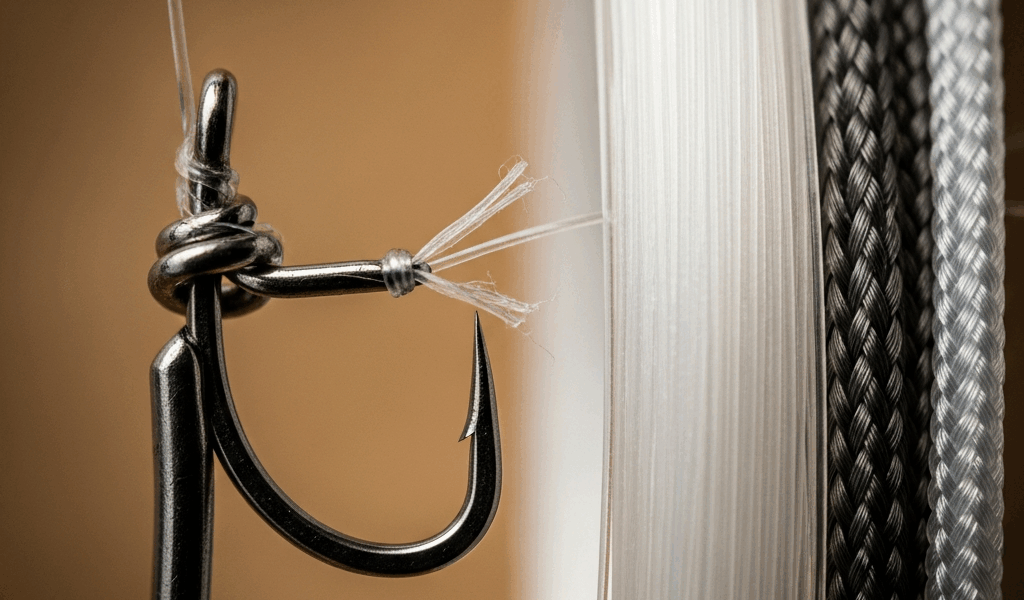
The Real Reasons Fishing Knots Fail
Fishing knots have gotten complicated with all the conflicting advice flying around. Wet it, don’t wet it. Use a Palomar. No, use a Clinch. Seven wraps minimum. Actually, five is fine.
As someone who’s lost genuinely embarrassing fish to bad knots — including a 30-pound striped bass off Cape Cod in 2019 — I learned everything there is to know about why knots actually fail. Today, I will share it all with you.
Here’s the thing most anglers get wrong: they blame the knot itself. The knot is rarely the problem. Execution is. Line choice is. The specific way you’re cinching is. I know because I stood on that charter boat holding a limp piece of 20-pound fluorocarbon, staring at where my Improved Clinch used to be. The knot wasn’t flawed. My technique was.
Knot failure breaks down into three categories. Improper seating — the knot didn’t tighten evenly, leaving slack or twisted loops. Wrong knot for the line type — a Palomar works beautifully on braid but can slip on stiff fluorocarbon. Friction damage from a dry cinch — you pulled tight without wetting it, and the heat destroyed the line right at the failure point.
Once you know which category you’re dealing with, the fix becomes obvious.
You Pulled It Tight Without Wetting It First
Probably should have opened with this section, honestly.
This one catches more anglers than anything else. You tie the knot, grip both ends, cinch hard. That friction heats the monofilament or fluorocarbon. The heat weakens the line’s molecular structure at exactly the point where you need it strongest. You’ve essentially pre-damaged your own rig before the first cast.
Braid handles this better — its construction spreads friction across multiple strands. Fluorocarbon, though? Fluorocarbon hates a dry cinch. It’s stiff, it’s dense, and it loses somewhere between 20 and 40 percent of its rated breaking strength when you heat-damage it on the pull. That 20-pound fluoro you trusted? Suddenly it’s performing closer to 12.
The fix costs nothing and takes two seconds. Wet the knot before you cinch. Saliva works. Water from your bottle works slightly better — a few drops is enough. One lick across the line before you pull changes everything.
Pull steadily, not explosively. Slow and controlled lets the friction dissipate instead of concentrating in one spot. You want the knot snug and seated, not cooked into the line.
If you only remember one thing from this entire article, remember that. Wet the knot before you pull it tight. Everything else is secondary.
Your Knot Does Not Match Your Line
But what is knot-line compatibility? In essence, it’s matching a knot’s mechanical behavior — how it grips, cinches, and holds under load — to the physical properties of your specific line. But it’s much more than that. It’s understanding why certain combinations fail at the worst possible moment.
That’s what makes this frustrating for anglers who’ve been tying the same knot for 20 years. It worked on mono. It’s worked forever. Then they switch to fluorocarbon and start losing fish for no apparent reason.
Here’s where the mismatch actually hurts:
- Improved Clinch on braid: The Improved Clinch holds by having the line grip itself through friction as the loops cinch down. Braided line is slippery — the wraps slide past each other under load. You need at least seven to eight wraps on braid versus five or six on mono. Even with that adjustment, most serious braid anglers have switched to the Palomar entirely.
- Palomar on fluorocarbon: The Palomar doubles your line, which creates a bulky knot. On stiff fluorocarbon — anything 16-pound test or heavier — that doubled section doesn’t cinch evenly. One loop tightens while the other stays slightly loose. The tag end pulls through under real pressure. Fluorocarbon prefers tighter spiral construction with more wraps. The Improved Clinch genuinely outperforms the Palomar on fluoro.
- Uni knot on mono under 10-pound: Light monofilament is soft and slippery enough that the Uni’s initial loop doesn’t seat under full pressure. Works fine on 12-pound and up. Below that, the knot migrates or slips incrementally — not all at once, just enough that you never fully trust it.
So, without further ado, let’s dive into what actually works. For monofilament and fluorocarbon between 10 and 20 pounds, the Improved Clinch is your workhorse. For braided line, run the Palomar or a Uni knot with an extra wrap. For ultralight mono under 8-pound, try a Clinch with one extra wrap or switch to a Uni and cinch it carefully.
The Wraps Are Wrong or the Tag End Is Too Short
I’m apparently obsessive about wrap counts and the half-inch tag end works for me while shorter trims never hold under real pressure. Don’t make my mistake of learning this during an actual fight with a fish.
Wrap count determines how much friction the knot generates. Too few wraps, and the knot slides under load. Too many, and the overkinking weakens the line. There’s a range that works — and it changes by line type.
Here are the counts that hold:
- Improved Clinch on monofilament: Five to six wraps for 10 to 15-pound test. Seven wraps for 20-pound and heavier.
- Improved Clinch on fluorocarbon: Six to seven wraps for 12 to 16-pound test. Eight wraps for 20-pound.
- Improved Clinch on braid: Seven to eight wraps minimum. Every time. Regardless of test weight.
- Palomar on braid: Two wraps — one loop — is the standard. That’s it. The simplicity is exactly why it works.
The tag end needs enough length to hold under pressure. A quarter inch is the absolute floor. I keep mine at a half inch — that extra material costs nothing and gives the knot something to grip if it shifts. Anything shorter than a quarter inch and you’re inviting the tag end to pull straight through the final loop.
Trim with nail clippers or a sharp knife. Not your teeth. Teeth fray the end and compromise the knot’s grip on that tag. A clean cut matters more than it sounds like it should.
How to Test Your Knot Before It Costs You a Fish
Testing separates anglers who lose fish from those who don’t. It takes 30 seconds. Most people skip it.
Secure the hook or lure in a vise or between your knees. Grip the main line and pull steadily with real force — not a timid tug, an actual load. A properly seated knot feels immovable. A slipping knot feels slightly greasy or loose even under moderate pressure. The tag end should not move independently of the main line. If it does, the knot isn’t fully cinched and you need to retie it.
Build this into a habit loop you run every single time:
- Tie the knot.
- Wet it — saliva or water, either works.
- Cinch steadily, not explosively.
- Trim the tag end to a half inch.
- Test it with a solid, sustained pull.
No exceptions. Every knot, every time. That’s the whole system.
Knot failure is almost always fixable once you know what category you’re in. Wet before you cinch. Match the knot to the line type. Count your wraps. Test before you fish. These aren’t advanced techniques — they’re the fundamentals. The stuff that separates the anglers who consistently land fish from the ones standing on the bank wondering what happened to their rig.




Stay in the loop
Get the latest fishing tales journal updates delivered to your inbox.