The Most Common Reasons Casts Fall Short
Casting distance has gotten complicated with all the conflicting advice flying around. Bad rod tip path. Wrong release point. Overloaded or starved rod. Mismatched line weight. A spool fighting you with drag and friction. Pick your poison — any one of these five mechanical failures will kill your distance before the lure ever leaves your hand.
The good news? Isolate the actual culprit and you can fix it before your next trip out.
Your Release Point Is Off — Here’s How to Fix It
I spent two full seasons convinced my casting arm was just weak. Embarrassing, honestly. Turns out my release was happening at the single worst possible moment — right while the rod was still accelerating but hadn’t finished loading. Two seasons of that nonsense.
Release timing controls distance. Full stop. More than arm strength ever will. Release too early and the lure climbs high in a steep arc, burning all its energy going up instead of out. Release too late and the rod has already dumped its stored energy — the lure just drops at your feet like you threw it underhand into a bucket.
Here’s the tactile way I think about it. Picture a clock face. Twelve o’clock is straight up. Two o’clock is pointing forward over the water. On your backcast, the rod tip travels to about 1 o’clock. On the forward cast, you accelerate and release somewhere between 10 and 11 o’clock — while the rod is still moving toward 2 o’clock but hasn’t arrived there yet. That’s the window. The rod should still be doing work when the lure leaves your fingers.
Here’s a drill worth doing in your yard before you ever hit the water. Grab a practice plug — a $4 rubber casting weight from any tackle shop works fine. Make five casts releasing at 10:30 on the clock. Five more at 11:00. Five at 11:30. You’ll feel the difference immediately. The 10:30 release sails. The 11:30 release thuds down short like you gave up halfway through. Your sweet spot lives somewhere in that range, and once you find it, muscle memory locks it in faster than you’d expect.
Don’t adjust anything else during this drill. Not arm speed. Not grip pressure. Just the release. One variable at a time is how you actually solve the problem instead of chasing ghosts forever.
Rod Loading and Why You’re Killing Your Own Power
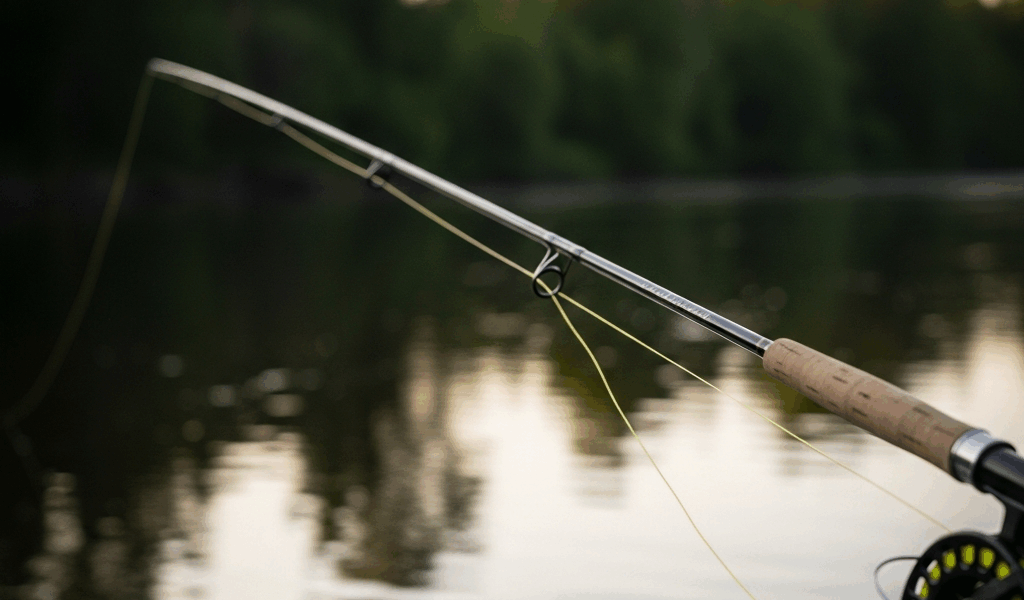
Rod loading isn’t mystical. It’s physics you can feel in your hand. The rod bends, stores energy, then transfers that energy into the lure on the release. Simple. What kills it is overpowering the forward stroke — unloading the rod before you ever reach your release point.
Don’t make my mistake. For years I muscled the forward cast like I was swinging a Louisville Slugger. Hard acceleration right from the start, violent snap at the top. What actually happened — the rod bent too fast, too far, and was already unloading by the time I released. All that stored energy had nowhere useful to go. Lure landed fifty feet out while I stood there wondering why the guy next to me was hitting eighty.
The correct forward stroke is smooth acceleration. Start slow, speed up through the cast. By the time you hit 10 o’clock, you’re moving fast — but the rod is still loading because you’ve been building speed gradually the whole time. The rod actually finishes its work after the lure leaves your hand. That’s what distance feels like when it’s working right.
This gets significantly worse if your rod action is wrong for your lure weight. Fast action rods — I’m talking something like a St. Croix Mojo Bass in heavy — are stiff. They load quickly and unload quickly. Throw a quarter-ounce jig on a fast action rod and the whole loading cycle happens before you reach your release window. You’re releasing into a dead stick. The rod is already done and you haven’t even let go yet.
Medium action rods are more forgiving — they bend deeper and take longer to fully load, which means they’re still working right at your release point. Throwing light stuff? A quarter-ounce jig head, a small inline spinner, a 2-inch tube rigged weightless — a medium action rod will add ten to fifteen honest feet compared to a fast action rod of the same length.
Check the rod’s rated lure weight. It’s printed right on the blank near the handle, usually something like 1/8–3/8 oz. Throw lures lighter than that rating and the rod never fully loads. Throw heavier and you’re forcing an early unload. Match your lure weight to that printed sweet spot and watch what happens to your distance.
Line Weight and Spool Problems That Steal Distance
Heavy line drags through the air. Not dramatically — it’s not like throwing rope — but 20-pound monofilament creates measurably more air resistance than 10-pound monofilament does. I’m apparently a 8-pound fluorocarbon angler and Berkley Trilene 100% Fluoro works for me while heavier mainlines never feel right on my spinning setups. Your mileage will vary, but the physics don’t.
That said, line weight isn’t even the most common line problem I run into. The most common problem is spool fill — and most anglers never even look at it.
An underfilled spool creates friction as line peels off against the reel frame. The arbor is narrower at the center than at the lip, so line coming off an underfilled spool fights constant resistance on every cast. Overfilled is equally bad — line packs tight, doesn’t release cleanly, and tangles at the worst moments. Either way you’re losing ten to twenty feet of distance without ever knowing why.
Fill your spool properly. Most reels have a fill line marked right on the spool — fill to that line, not past it, not well below it. If you’re running light mainline and need backing to reach the fill line, use something thinner than your mainline as the base. I run 20-pound PowerPro braid as backing under 6-pound monofilament on my 2500-size spinning reels. The thinner braid takes up less volume, the monofilament peels off the top cleanly, no bunching.
Underfilled? Add mainline. So overfilled the handle barely turns? Strip it down and respool properly. That’s what the setup requires, and no amount of stroke improvement fixes a spool that’s fighting you.
Quick Drills to Add Distance Before Your Next Trip
Probably should have opened with this section, honestly. You don’t need hours on the water. You need thirty focused minutes on one variable at a time, ideally in your backyard before the trip.
Start with the release point drill. A half-ounce practice plug — the Danielson rubber casting weight runs about $3.50 at most shops — is perfect for this. Open area in front of you, ten casts focused entirely on the moment the lure leaves your fingers. Not distance. Not power. Just that release window between 10 and 11 o’clock. Once it feels consistent, then add distance focus. Not before.
Second drill: load testing. Feel the rod actually bend on the backcast. Feel the acceleration build on the forward stroke. If the rod feels stiff and quick to unload — snapping back before you reach your release window — you’ve either got the wrong rod action for your lure or the wrong lure weight for your rod. Swap one variable and cast again. That’s the whole drill.
Third drill: cast into the wind. This one exposes bad mechanics faster than anything else. A cast that looks fine in dead calm falls completely apart in a 10-mph headwind if your release is off or your loading is weak. Five casts into a stiff breeze will teach you more than fifty casts in still air. That’s what makes wind so useful to us anglers who are actually trying to improve.
So, without further ado — go find some wind and a practice plug. You’re probably one mechanical fix away from the distance you’ve been chasing.



Stay in the loop
Get the latest fishing tales journal updates delivered to your inbox.