What a Backlash Is Actually Telling You
Baitcasting has gotten complicated with all the conflicting advice flying around. Everyone’s got a YouTube opinion. But backlashes — the thing that makes beginners want to hurl a $200 reel into the lake — are actually simple once you understand what’s happening mechanically.
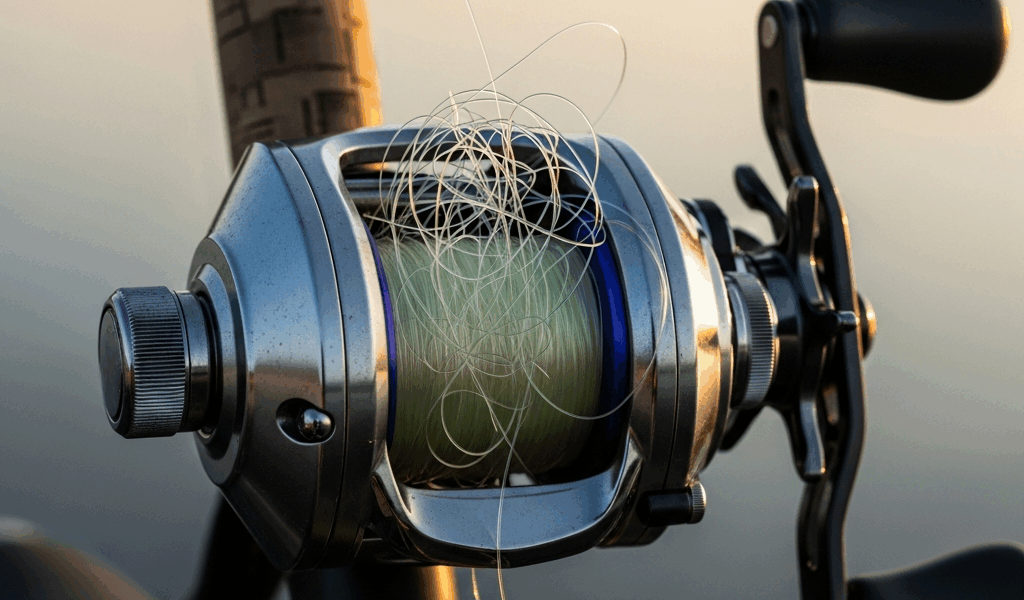
So here’s the core of it. A backlash happens when your spool spins faster than line leaves the reel. The spool wants to keep accelerating after your thumb lifts off, but the lure isn’t pulling line away fast enough to match. What you get is a tangled nest — line wrapping over itself, around itself, into a catastrophic bird’s nest you’ll spend twenty minutes picking apart on the bank.
But what is a backlash, really? In essence, it’s a timing mismatch between spool speed and lure speed. But it’s much more than that. It’s actually diagnostic information. Every single backlash is your setup — or your technique — telling you something specific needs fixing. That’s what makes understanding the causes so valuable to us baitcaster anglers. Work through them in the right order and you can eliminate ninety percent of backlashes almost entirely.
So, without further ado, let’s dive in.
Your Spool Tension Is Set Too Loose
Probably should have opened with this section, honestly.
This is the most common culprit. I’m apparently someone who wasted two full afternoons blaming a perfectly good Shimano Curado when the spool tension knob was just set wrong, and fixing it took about forty-five seconds. Don’t make my mistake.
The spool tension knob applies resistance directly to the spool. Loose means the spool overshoots. Tight means you sacrifice distance. Most reels ship from the factory with tension backed completely off so nothing gets damaged rattling around in the box — which means you have to dial it in yourself before the first cast. Most people don’t. Most people just pick up the reel and throw.
Here’s the test that actually works:
- Loosen the spool tension knob until your lure drops freely when you disengage the reel and hold it horizontal.
- Tighten the knob slowly until the lure falls at a controlled rate — roughly one second per foot of drop — and stops on its own without spool overrun.
- That’s your baseline. You’ll fine-tune it with different lure weights, but start here every time you switch setups.
Once I got my tension right on that Curado, backlashes dropped from nearly every cast to almost never. Same reel. Same water. Different knob position.
Your Brake System Isn’t Matched to the Lure Weight
Baitcasters have two brake systems: magnetic and centrifugal. Magnetic might be the best option for beginners, as baitcasting requires consistent mid-cast adjustment. That is because magnetic brakes respond to spool speed dynamically — the faster the spool spins, the more resistance engages. You adjust them with a dial, usually numbered zero to ten on the side plate.
Centrifugal brakes use physical weights that swing outward as the spool accelerates. Mechanical, fixed, and they don’t modulate mid-cast the way magnetic systems do. Both slow the spool. They just do it differently.
Here’s what kills beginners: setting brakes at zero because zero sounds like “maximum distance.” It doesn’t mean that. Zero brakes means zero safety net. The moment conditions shift — wind picks up, you throw a lighter lure, your thumb hesitates a half-second — your spool backlashes hard.
A better approach for most people starting out:
- Quarter-ounce to half-ounce cranks and spinnerbaits — start at fifty to seventy-five percent brake.
- Three-quarter ounce and heavier — dial back the brake, since lure weight naturally resists overspin.
- Topwater baits and light finesse stuff — more brake, not less, because they barely pull line off the spool.
While you won’t need to run maximum brakes forever, you will need a handful of real casting sessions before dialing down toward what the pros run. Don’t chase videos of tournament anglers throwing featherweight lures at zero brakes on no-wind days. That’s not your starting point — at least if you want to keep your line intact.
Your Casting Stroke Is Creating the Problem
Mechanical issues get all the attention. Technique errors cause just as many backlashes. Two mistakes show up constantly.
First, releasing your thumb too early. Your thumb leaves the spool before the lure peaks in velocity, and the spool keeps accelerating into empty air. Brakes help, but they can’t fully compensate. The fix is feathering — keeping light thumb contact on the spool throughout the cast, not just at the release point. Until the lure is already traveling downrange, maintain contact.
Second, punching the cast instead of loading it. A loaded cast uses your wrist and forearm to flex the rod — storing energy that transfers smoothly into lure speed. A punch is a jerky, arm-driven motion that accelerates everything unevenly and sends the spool spinning before the line can possibly keep up. You can feel the difference immediately. A loaded cast feels like you’re throwing the rod tip. A punch feels like you’re throwing the lure itself with brute force.
I’m apparently someone who spent three weeks assuming a used Lew’s Speed Spool was defective. Casting like I’d grabbed a spinning rod by accident — that was the actual problem. Switched to loading mechanics and that reel ran clean. Don’t make my mistake.
Wind and Line Condition Are Silent Contributors
Frustrated by backlashes that appeared randomly on otherwise good casts, I started tracking conditions and eventually noticed a pattern: headwinds, always headwinds. Wind slows your lure without touching your spool. Cast anything lighter than half an ounce into a stiff headwind and the lure hits air resistance while the spool is still spinning up. Backlash follows instantly.
Simple fix: cast with the wind when possible. On windy days, dial your brake up two clicks — a Lew’s at setting four goes to six, an Abu at thirty percent goes to fifty. You lose some distance. You stop losing afternoons to nest-picking.
Line condition gets overlooked constantly. Old monofilament and even older fluorocarbon develops memory — permanent coils baked in from sitting on the spool. When those coils rotate through the levelwind during a cast, they create micro-snags. The lure slows. The spool doesn’t. Backlash. Check your line every few months. If it looks coiled or fuzzy or generally sad, replace it — a fresh spool of fifteen-pound Berkley Trilene runs about eight dollars. That’s a cheap fix for a frustrating problem.
Also check spool fill level. An overfilled spool — line packed right to the rim — backlashes far more easily than one filled to a quarter-inch below the edge. Underfilling costs you distance but saves your sanity while you’re learning.
This new understanding of the sequence took off for me over several seasons and eventually evolved into the systematic approach baitcaster anglers know and rely on today: tension first, then brakes, then stroke, then environment. Work through it in that order. Most reels aren’t broken — they’re just set wrong or thrown wrong. Fix those things and you’ll wonder why you ever blamed the equipment.



Stay in the loop
Get the latest fishing tales journal updates delivered to your inbox.