Fishing Knots Have Gotten Complicated With All the Conflicting Advice Flying Around
Your knot keeps slipping. You’ve retied it three times. You’ve burned through a Tuesday evening watching YouTube tutorials. You know the mechanics cold. And then a decent fish pulls hard and — gone. Again.
Here’s the thing nobody leads with: most knot slippage has nothing to do with your tying technique. You’re probably doing it right. The real problem is a mismatch between the knot you picked and the line material it’s sitting on. A Palomar that holds all day on 15-pound mono can slip catastrophically on 20-pound braid using that exact same tying motion. An Improved Clinch that works beautifully on regular monofilament loses its grip on fluorocarbon under sustained drag pressure. Different materials. Different behavior. Most people never connect those dots.
The real diagnostic doesn’t start with retying. It starts with identifying your line type and matching it to a knot actually designed to grip that material.
How to Tell If Your Knot Slipped or Just Broke
Before you fix anything, figure out what actually happened. This changes everything.
After a failure, look at the tag end — that short leftover piece of line sticking out from the knot. It tells the whole story.
On Monofilament
A slipped knot leaves a clean, spiraled curl at the tag end. Sometimes a little pigtail. The line unraveled gradually. No real damage to the line itself — just a neat coil sitting there mocking you. That curl is your signal the knot body released under pressure rather than the line snapping.
On Fluorocarbon
Slippage on fluoro shows differently. You’ll get a smoothly peeled tag end, often with a slight gloss where it pulled through. Fluoro doesn’t curl the way mono does. Look for a tapered, almost polished appearance where the line exited the knot — like someone ran a thumbnail down it.
On Braid
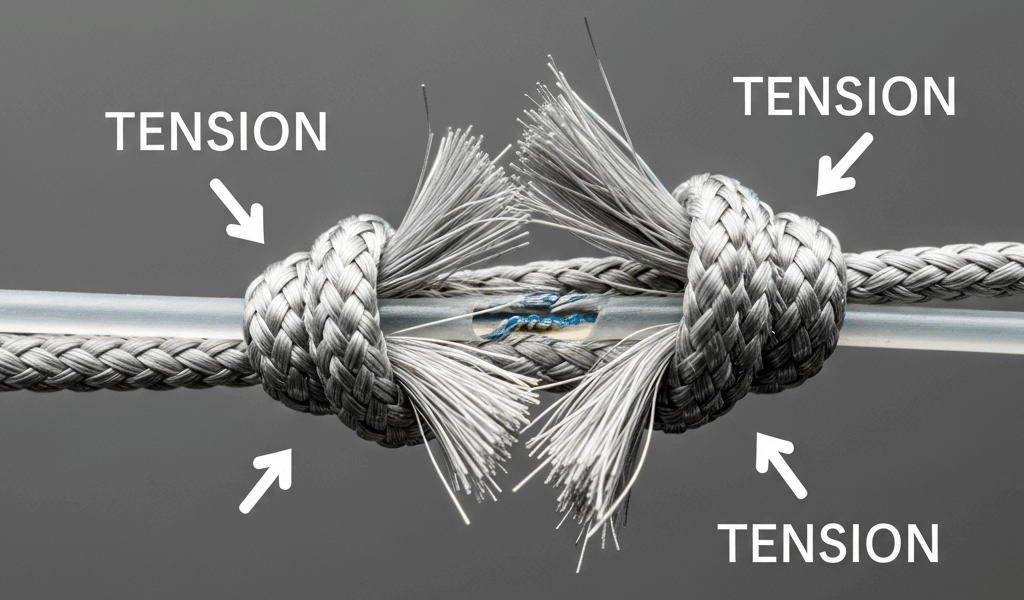
This one’s obvious once you’ve seen it. A slipped knot on braid leaves the strands fanning out and separating — like the frayed end of an old rope. The braided structure literally comes apart as it slides. Individual filaments splayed everywhere. Not a clean break. Nothing subtle about it.
Actual breakage looks different across all three line types. Clean snap. Sometimes blunt, sometimes slightly frayed at the edge, but not that gradual unraveling pattern you get from a slip. The break happens at one concentrated point rather than distributed along the tag end.
Why does this distinction matter? A slip means you need a different knot or better knot seating before you touch the water again. A break means the knot itself held fine — the line failed, probably from UV damage, abrasion, or a flaw in the material. Two completely different problems. Two completely different fixes.
The Most Common Knot and Line Mismatches
Three scenarios account for probably 70% of the slipping complaints I’ve either troubleshot for other people or lived through personally.
Palomar on Heavy Braid — The Bite Point Problem
But what is a bite point failure? In essence, it’s when a knot can’t grip the line material the way it was designed to. But it’s much more than that — it’s a materials problem disguised as a technique problem, and that’s why it’s so frustrating to diagnose.
The Palomar is legendary. Pair it with 20-pound or heavier braid and a hook with a wide eye, though, and you get compression failure. Braid doesn’t compress the way mono does. When you cinch a Palomar on braid, the knot body wants to bite into the line strands. With braid’s low-stretch properties and woven structure, that bite point becomes a concentrated stress zone rather than a gradual grip. Under heavy drag, the whole thing can suddenly release. No warning. Just gone.
I lost a solid 18-pound striped bass that way. Tied a Palomar on 20-pound Power Pro to a 5/0 wide-gap hook. Fight started fine. Three minutes in — drag screaming, rod bent hard — the knot gave. That characteristic braid fan-out on the tag end told me exactly what happened. That was 2019. I haven’t tied a Palomar on heavy braid with a wide-eye hook since.
Improved Clinch on Fluorocarbon — Sustained Pressure Failure
Fluoro is stiff. Less forgiving than mono by a significant margin. The Improved Clinch wraps the line back on itself, and fluoro’s rigidity actively works against that design — the line wants to straighten. Under constant, heavy drag pressure — not the initial strike, but sustained pulling over a long fight — the wraps gradually loosen. It’s not a catastrophic slip. It’s a slow creep.
You might not notice until you set the hook and realize you’ve already lost six feet of line without the fish moving an inch. The knot didn’t spectacularly fail. It just quietly let go while you weren’t watching. That’s almost worse, honestly.
Wet Knot Neglect — Universal Killer
Probably should have opened with this section, honestly. This one applies to every line type and nearly every knot in existence. You tie it dry. The friction from cinching heats the line — sometimes enough to weaken it right at the knot. You don’t wet it. When you set the drag and make that first cast, that heated knot is already under stress before it even has a chance to seat properly. The line slips against itself in those first few seconds of actual pressure. Don’t make my mistake — wet every knot before you snug it down. Every single one.
How to Fix a Slipping Knot Without Retying Everything
You’re at the water. You felt the knot slip but didn’t lose the fish yet. Here’s the field fix — four steps, takes about ninety seconds.
- Wet it immediately. Saliva works faster than water because it lowers surface tension — the knot seats into the line structure more effectively. Pour water over it if you’ve run out of saliva. Either beats nothing.
- Apply slow, steady tension. Don’t jerk. Use thumb and forefinger to hold the tag end while you tighten the main line with deliberate, steady pressure. Thirty seconds of slow tension lets the knot reset into the line — the wraps slide into their proper bite points without distorting the structure.
- Check tag end length. On mono, at least a quarter-inch sticking out. On braid, half-inch minimum. On fluoro, a quarter-inch — but verify it’s actually secured, because fluoro tag ends can look fine and be deceptively insecure.
- Test it before you cast. Grab the leader and the main line and pull hard. You’re looking for zero movement at the knot junction. It should feel fused, not like something that might shift under pressure.
This works maybe 80% of the time for slippage that hasn’t fully opened the knot. If the knot is completely loose, you’re retying. No shortcut there.
Which Knots Actually Hold Under Heavy Drag
So, without further ado, let’s dive in — but with one rule first. Don’t tie a knot because it’s famous. Tie it because it matches your specific setup.
Palomar for braid still performs, but only on hooks with smaller eye diameters — think a size 1 or 1/0 with a standard eye, not a wide-gap 5/0. Commit to a solid wet-down before applying any pressure. The smaller the eye, the less compression distortion you get at the knot body.
Double Uni for braid-to-fluorocarbon connections outperforms almost everything else in saltwater situations. I’m apparently a five-turn-on-each-side person and that configuration works for me while four turns never quite does on braid over 30-pound. Test it yourself at the vise before you trust it on the water.
Trilene knot for mono and fluoro to terminal tackle — simple five-turn wrap, thread back through the eye twice, cinch. Holds on both line types without the compression failure you get from more complex designs. $4 spool of 17-pound Trilene XL, a size 2/0 hook, three minutes at a kitchen table. That’s the whole setup.
First cast of every single day: tie your knot, wet it thoroughly, and pull hard on the leader. If you feel any movement at all, you retie right then. Not after you’re already in a fight with the fish of the season. Right then.

Stay in the loop
Get the latest fishing tales journal updates delivered to your inbox.