What It Actually Means When Your Crankbait Won’t Track Straight
Crankbait tuning has gotten complicated with all the conflicting advice flying around. As someone who has spent way too many mornings on the water fighting a lure that refused to behave, I learned everything there is to know about tracking problems — usually by making every mistake first. Today, I’ll share it all with you.
A crankbait running true means one thing: it goes straight. Dives clean. You feel that wobble kick in, and the bait stays exactly where you put it. Simple. But one that veers off to the side? That’s a different story entirely — like driving a car where the wheel pulls hard left the second you let go. You’re wrestling the rod the whole retrieve just to keep things honest.
And it matters more than people think. A bait tracking off-center isn’t covering the water you think it’s covering. The wobble goes lopsided — exaggerated on one side, suppressed on the other. Fish notice that. They’ll smash something that looks wounded, sure, but a crankbait that looks mechanically broken? That looks like something to swim away from. There’s a difference between hurt and wrong.
Start With the Line Tie Eyelet — Seriously, Start There
Probably should have opened with this section, honestly. The line tie eyelet is the culprit the vast majority of the time. Bent eye. That’s it. That’s the whole mystery for most tracking problems people spend hours diagnosing.
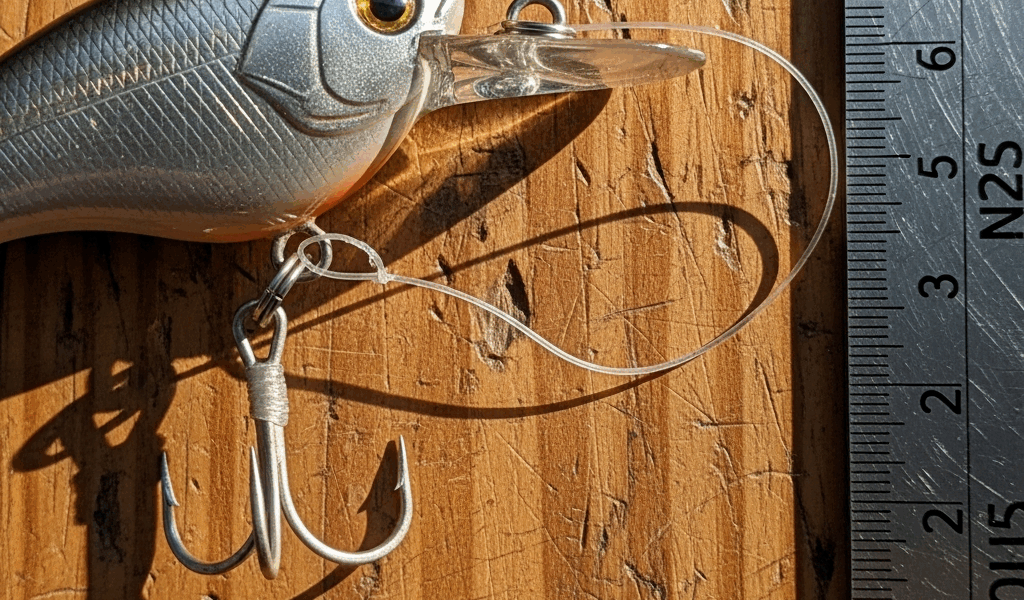
But what is the line tie eyelet doing exactly? In essence, it’s the anchor point where your line connects to the bait — and it screws into the head at a very specific angle. But it’s much more than just a connection point. That angle determines how the bait sits under load. Bend it even slightly off-axis and the nose gets pulled into the turn. Water pressure at higher retrieve speeds amplifies everything. A small bend becomes a hard run.
Visual inspection first. Hold the bait at eye level and sight straight down the eyelet from the front. It should sit dead center on the lure’s face — not tilted left, not canted right. If it’s twisted, the bait will track that direction without fail.
Fixing it means needle-nose pliers and patience. Clamp the eyelet — not the body, the eyelet — and apply slow pressure opposite the direction the bait runs. Micro-adjustments. Don’t muscle it. I’m apparently an overcorrector, and a Rapala DT-10 I paid $13.49 for at Bass Pro learned that lesson the hard way. Don’t make my mistake.
Here’s the step most people skip: test after every single adjustment. One small bend, then retrieve it in a bucket or alongside a dock at close range. Watch the nose. Adjust again if it needs it. Takes ten minutes instead of ninety seconds — but you won’t end up with a permanently mangled eyelet that no amount of bending will fix.
Check That Lip — Chips and Warps Will Kill Your Tune
The diving lip is the other major offender. A chip on one edge, a hairline crack, even slight warping from bouncing off a rock changes how water moves across that surface. One side pushes harder. The bait tracks toward the lighter pressure side. Every time.
Run your thumbnail across both edges of the lip. Smooth and even means normal wear. A dull spot, a white stress line, or a visible notch means damage. Then hold the bait up to a light source — phone flashlight works fine — and look for cracks running through the plastic. Sight down the lip from the front. It should form a clean, symmetrical curve. Any twist, any warp, and you’ve got a mechanical problem no eyelet adjustment will solve.
I learned this one the hard way. Dropped a Strike King 5XD on a concrete boat ramp — that was a bad morning — and the left edge of the lip took a tiny chip. Invisible at casual glance. Spent twenty-plus minutes tweaking the eyelet before I finally held it to my phone flashlight and saw the crack running maybe 4mm into the plastic. Wasted time on a $10 bait that needed to be retired, not tuned.
That’s the honest answer with serious lip damage: retire it. You can smooth a rough edge with 400-grit sandpaper — sometimes that’s enough for minor stuff. But structural cracks and warping aren’t field-fixable. The tracking problem is mechanical, not adjustable. Cut your losses.
Hook Weight Matters More Than You’d Think
Mismatched replacement hooks throw off the bait’s balance — and this one catches people off guard because it feels like such a small thing. Stock hooks aren’t arbitrary. Manufacturers engineer them into the bait’s overall weight distribution. Swap the belly treble for a heavier-gauge hook and you’ve shifted the center of gravity.
The classic mistake: replacing a worn tail treble with a beefier hook because you want something stronger. A Mustad 3366 #4 weighs differently than an Owner ST-36 #4. We’re talking fractions of a gram. On a half-ounce crankbait, fractions of a gram are not trivial. The nose tracks toward the heaviest point — add weight to one side and that side wins.
I’m apparently a kitchen scale person now, which my fishing buddies find ridiculous. But it works. Weigh each treble individually, compare against OEM specs — most manufacturers list original hook sizes on their website or in the packaging — and if something’s off, swap back to stock as a diagnostic step. If the bait suddenly runs true, you found it.
Worth knowing: belly hook weight matters more than tail hook weight for tracking. The belly hook sits closer to the bait’s center axis. A heavy tail treble still creates problems, but the belly is where mismatches hit hardest.
Tune for the Conditions You’re Actually Fishing
Moving water and still water are not the same thing for tuning purposes. A bait dialed in perfectly on a calm pond will behave differently in current. That’s not a flaw — that’s physics. Current changes the forces pulling on the bait. Your tuning interacts with those forces differently depending on where you are.
Most anglers — myself included for a long time — tune crankbaits at home. Bathtub, driveway bucket, calm pond. Then they get on a river with any kind of flow and assume something’s wrong when the bait drifts. Sometimes it’s not wrong. It’s just in a different environment.
Field testing should happen at actual fishing depth and actual fishing speed. Cast parallel to the bank at the retrieve speed you’ll use on the water — medium tempo, not slow-roll, not burning it. Watch the nose at close range, within a rod’s length. A slight drift at very slow speeds is normal and honestly not worth worrying about. Fish don’t retrieve crankbaits slowly. Only the speed you actually fish matters for tuning purposes.
Minor deviation under low pressure? Acceptable. Pronounced tracking at your normal retrieve speed? Something’s genuinely wrong — and it’s almost always the eyelet, the lip, or the hook weight. That’s ninety percent of cases right there. Work through those three in order, test after each fix, and you’ll stop losing casts to a lure that’s fighting you instead of working for you.




Stay in the loop
Get the latest fishing tales journal updates delivered to your inbox.