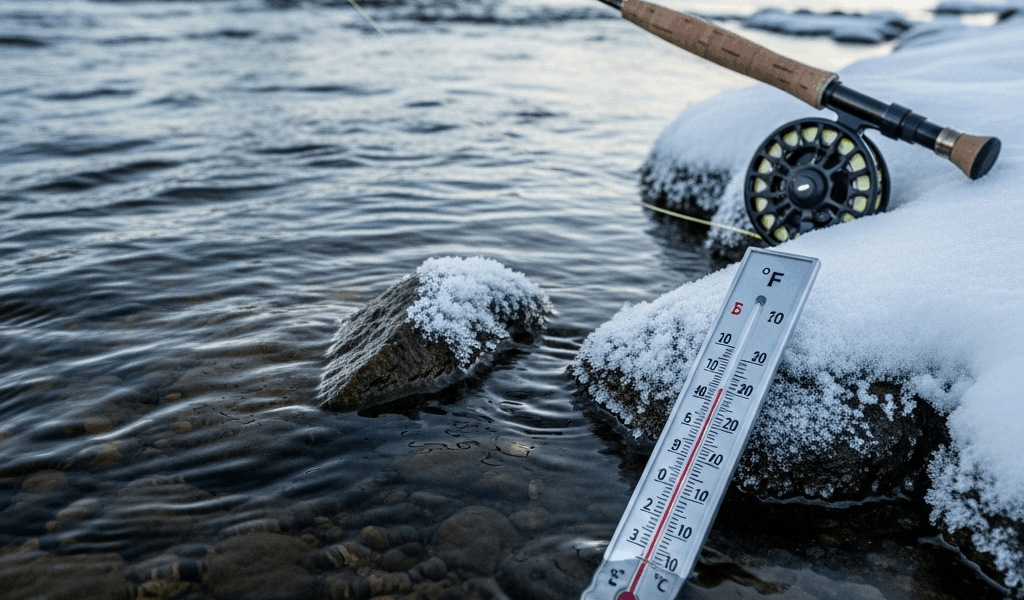
Why Trout Stop Biting in Cold Winter Water
Winter trout fishing has gotten complicated with all the conflicting advice flying around.
Most articles stop at “trout get sluggish.” Technically true. Also completely useless — like telling someone their car won’t start and then walking away. What you actually need to know is what sluggish means for your presentation on the water, and more importantly, what to do about it before lunch.
What Cold Water Actually Does to Trout
But what is the cold-water feeding shutdown, exactly? In essence, it’s a metabolic response that rewrites every instinct the fish had three months ago. But it’s much more than that.
Below 48 degrees, trout metabolism drops hard. They’re ectothermic — body temperature follows the water, not the other way around. Everything slows: digestion, movement, reaction time. A trout that burned 100 calories chasing streamers in September now scrapes by on 30 calories in December. The math changes completely.
In fall, that same fish might chase a streamer from five feet out. Come January at 40 degrees, it won’t move more than 12 inches. Not because it’s lazy. Because it can’t afford to. If chasing your lure costs more energy than the lure is worth, the fish refuses. You’re asking it to spend a dollar to earn 50 cents. So, without further ado, let’s dive in.
You Are Retrieving Too Fast for the Conditions
Probably should have opened with this section, honestly.
This is where I made my first real winter mistake. Late November, throwing a 3-inch Rapala around a bend pool on the Farmington, stripping it fast the way I always did in October. Blanked completely. Meanwhile, a guide two boats over landed six fish on a dead-drifted soft plastic. Six. I counted.
Don’t make my mistake.
Trout in cold water won’t chase. Full stop. If your retrieve covers more than a foot per second, you’re already moving too fast. I’m apparently wired to fish too aggressively — my instinct is always to speed up when nothing’s hitting — and slowing down genuinely never felt natural to me until I started watching guides work winter pools.
Here’s what actually works: the count-down method. Cast, let the lure sink for a five-count, retrieve so slowly you’re fighting the urge to go faster. Genuinely boring. The lure should move like something injured, not something hunting. Most winter anglers fish 20 percent too fast even when they think they’re crawling.
For rigs, downsize everything. Tungsten jigs at 1/16-ounce — tungsten over lead because you get the same weight in a smaller profile, which matters. Soft plastic grubs in olive, brown, or black. Inline spinners barely ticking over the bottom. Minimal flash. Maximum time in front of the fish.
Dead-drift under a bobber also crushes in winter. Feels passive. Works anyway. Cold-water trout will eat something that drifts to them — zero effort required on their part. I’ve out-fished active strippers three-to-one on winter days by letting a 1/16-ounce jig and soft plastic tumble through a pool on a dead drift. Three to one.
You Are Fishing the Wrong Depth
Winter trout don’t scatter. That’s a summer thing. Instead, they stack in thermal sweet spots — usually 12 to 24 inches deeper than surrounding water, in slow-moving areas where the current doesn’t force constant energy expenditure.
The mistake most anglers make is fishing top to bottom randomly. Start shallow in slow areas, work deeper methodically. Tail-outs of pools are reliable because the current slows there. Deep slots behind large boulders. Inside bends where silt accumulates. These aren’t arbitrary — they’re the spots where a cold trout can hold without working.
Even 18 inches of depth difference matters. I’ve had days where the productive zone ran from 24 to 36 inches, and everything shallower was completely dead. You find that zone by fishing systematically, not by guessing at it.
In lakes, trout often suspend just above the thermocline — usually 20 to 40 feet depending on the basin. Use a depth finder if you have one. If not, ask at a local fly shop or pull up a topo map showing basin depth. The Farmington below the reservoir holds fish in 28 to 34 feet most winters. That’s not a guess. That’s a number worth knowing.
Your Presentation Is Too Aggressive
Size matters in cold water. A lot.
While you won’t need a complete tackle overhaul, you will need a handful of adjustments that feel uncomfortably small. Drop to 1/16-ounce or 1/8-ounce offerings. The smaller profile sinks faster and displaces less water — both things cautious cold-water trout respond to.
Color: naturals only. Olive, brown, black, tan. Fluorocarbon might be the best option for line, as cold-water trout require low visibility above everything else. That is because clear winter water makes standard monofilament visible enough to spook fish that would have ignored it in October. Drop to 2- to 4-pound-test fluorocarbon when you’re throwing small jigs. It’s not optional.
Anything loud fails. Crankbaits with rattles, spinners with aggressive blade thump — trout ignore them in cold water. Silent presentations with gentle movement get strikes. I switched to a Panther Martin size 2 spinner last February, slowed my retrieve to almost nothing, and started catching fish that had ignored everything louder all morning. That was a $4.99 lure. Sometimes it’s that simple.
Best Times to Target Trout When the Water Is Cold
Timing is your edge in winter. Cold-water trout feed in windows — not all day, not randomly.
Midday wins. Even in January, surface water warms slightly between 11 a.m. and 2 p.m. Not dramatically — maybe 2 or 3 degrees — but enough to nudge trout into feeding. Frustrated by early morning blanks one December, I started arriving at 10:30 a.m. instead of dawn and immediately started seeing more strikes using the same exact setup. Same water. Same lures. Different timing.
South-facing banks warm faster than north-facing water. Subtle, but real. Target those first.
Overcast days are underrated. Clouds trap slight warmth and diffuse light in ways that make trout less spooky. I’ve had better days on flat gray January afternoons than on bright sunny ones. Most anglers assume cloud cover kills the bite. It doesn’t — at least not in winter.
Here’s your game plan: pick a winter-accessible water nearby. Arrive around 10:30 a.m. with downsized soft plastics, tungsten jigs at 1/16-ounce, and one inline spinner. Fish the deepest slow zones with a dead-drift or count-down retrieve. No strip-and-move. Let the lure work. South-facing banks first. Stay until 3 p.m. before reassessing anything.
Cold water doesn’t mean no bites. It means the fish require a different kind of respect. Give them the right speed, the right depth, and the right size — and they’ll eat.



Stay in the loop
Get the latest fishing tales journal updates delivered to your inbox.