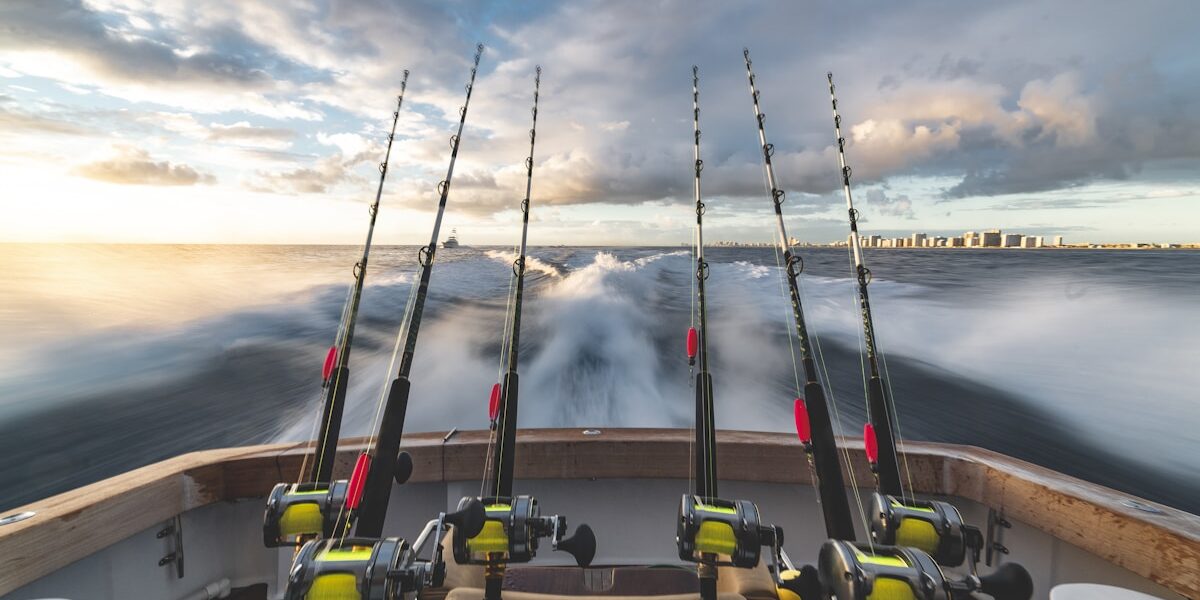
Trolling is one of those techniques that looks deceptively simple from the outside — you just drag stuff behind a moving boat. But the difference between a trolling spread that produces fish all day and one that produces nothing is almost entirely in the details: speed, depth, lure choice, spread geometry, and reading the sonar. I’ve spent a lot of mornings working out those details on the water. Here’s what actually matters.
Equipment Essentials
Trolling rods need to be stiffer than typical casting rods — you’re not setting a hook with a fast snap, you’re dealing with sustained pressure as the fish fights the boat’s momentum. Roller guides help on heavier setups where sustained pressure would otherwise groove standard guides. Reels should have smooth, adjustable drags — when a fish hits at trolling speed, the drag needs to give line immediately without spiking resistance.
Line choice matters for depth control. Monofilament stretches, which can actually be an advantage in some trolling situations by absorbing the initial strike impact. Braid has minimal stretch and transmits every rod tip movement to the lure, which can be a problem with some presentations. Lead core line is used for specific depth targeting — it sinks at a known rate (10 feet per color) and lets you troll lures at consistent depths without downriggers.
Lures for trolling include spoons (Acme Kastmaster, NK 28, Little Cleo), crankbaits designed to run at specific depths (Rapala DT series, Reef Runner), and various plugs. Paddletail swimbaits work well behind a snap weight. The key is knowing the running depth of your lure at your trolling speed — manufacturer dive charts are a starting point, but line diameter and length of line out affect depth significantly.
Understanding Trolling Techniques
Flat-lining is the simplest approach: let line out behind the boat without any additional weight or planer, and let the lure swim at whatever depth it naturally runs. Works well for fish near the surface or in 10-15 feet of water. The limitation is that all your flat-lined lures run in the same boat wake zone, which can spook fish in clear or heavily pressured water.
Planer boards solve that problem. They pull lures out to the side of the boat — sometimes 50-80 feet to the side — so lures are running through undisturbed water far from the boat’s path. In-line planers like the Off Shore Tackle OR-12 attach directly to the line; mast planers attach to a separate line and you clip your fishing line to them. In clear water with pressured fish, planer boards make a substantial difference in strike rate.
Downriggers are the precision tool for targeting fish at specific depths. A weight on a cable holds your lure at an exact depth — 35 feet, 52 feet, whatever the fish finder is showing — and when a fish hits, the line releases from the downrigger clip and you fight the fish directly. For salmon, lake trout, and walleye in deeper water, downriggers are the standard. They have a learning curve but become intuitive with use.
Trolling Speeds That Work
Speed is the variable most anglers adjust too infrequently. General ranges by species: salmon and lake trout, 1.8 to 3.0 mph; walleye, 1.5 to 2.5 mph; muskellunge, 3-5 mph; marlin and offshore species, 6-9 mph. But those are starting ranges — the right speed on a given day is whatever the fish are responding to, which might be 10% faster or slower than the “correct” speed.
I’m apparently more obsessive about GPS speed than most people on the boat, but it matters. When you get a strike, note your exact speed and compare it to non-strike passes. Sometimes the difference between a productive and unproductive troll is 0.3 mph. Make small incremental changes rather than large jumps and pay attention to when fish hit relative to your speed adjustments.
Choosing the Right Time and Place
Early morning — first light until about 8 AM — is consistently the best trolling window for most species. That’s when fish are most actively feeding and more willing to commit to a moving lure. Late evening from 6 PM until dark is the second-best window. Midday trolling in summer produces slower action, but fish are still catchable if you adjust depth.
Water structure drives everything. Depth transitions — where the bottom drops from 20 to 40 feet over a short distance — concentrate fish, particularly walleye and trout. Make repeated passes over productive transitions rather than randomly covering water. Weed edges, rock piles, and main lake points are also consistently worth multiple passes.
Wind creates current that concentrates baitfish, which concentrates predators. The up-current side of a point or a weed edge is often more productive than the calm side. When in doubt, fish into the wind.
Tech-Enhanced Trolling
A quality GPS/chartplotter and a good fish finder are the two pieces of technology that have the most direct impact on trolling success. GPS lets you track your exact path, mark productive areas, and repeat successful passes precisely. Running the same route you ran when you got a strike is often how you find a second fish — they hold in the same general area. A fish finder shows you whether fish are present at the depth your lures are running, which removes the guesswork from depth adjustments.
Electric trolling motors allow quiet, precise boat control that engine trolling at very slow speeds can’t always achieve. At under 1.5 mph for walleye or crappie trolling, a trolling motor running on the battery is far smoother and quieter than a gas engine at idle.
Environmental and Ethical Considerations
Trolling tends to produce larger, more mature fish than some other techniques because it covers water efficiently and lures are sized to attract larger predators. Release big fish when possible — a large lake trout or walleye represents many years of growth, and that fish contributes more to the population through future spawning than a slot-fish does. Follow catch limits, and always dispose of fishing line properly — monofilament and braid in the water tangles wildlife and doesn’t break down for centuries.
That’s the thing about trolling — when you figure it out on a particular body of water, it produces fish with a reliability that’s hard to match with any other technique. The time investment in understanding the water pays back over seasons of productive fishing.
Recommended Fishing Gear
Garmin GPSMAP 79s Marine GPS – $280.84
Rugged marine GPS handheld that floats in water.
Garmin inReach Mini 2 – $249.99
Compact satellite communicator for safety on the water.
As an Amazon Associate, we earn from qualifying purchases.

Stay in the loop
Get the latest fishing tales journal updates delivered to your inbox.