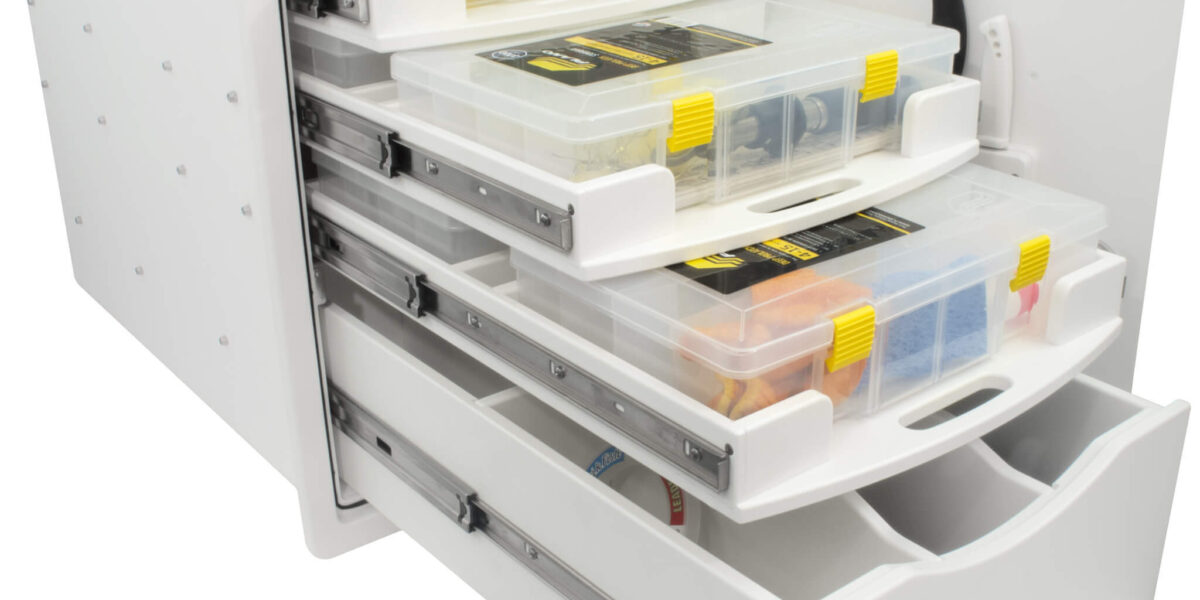
The best tackle storage system is the one that fits how you fish. A bank angler may need a light backpack and a few medium utility boxes, while a kayak angler needs a secured crate, fast one-handed access, and a plan for draining water. Boat anglers can carry larger trays, but still benefit from organizing by technique rather than bringing every lure they own.
This guide compares tackle boxes, bags, backpacks, and kayak crates by capacity, moisture control, portability, and access. Product examples are included to explain useful design choices—not to declare one universal winner.
Quick tackle-storage comparison
| System | Best fit | Main advantage | Main tradeoff |
|---|---|---|---|
| Modular utility boxes | Most anglers | Easy to label, swap, and stack | Requires a bag, crate, or compartment |
| Soft tackle bag | Boat and bank fishing | Good tray access plus exterior pockets | Fabric can hold spray and dirt |
| Tackle backpack | Anglers who walk | Keeps both hands free | Easy to overpack and make too heavy |
| Hard tackle box | Piers, docks, and organized transport | Rigid protection and simple access | Awkward over long distances |
| Kayak crate | Sit-on-top kayaks | Secure, customizable rear-deck storage | Must fit and attach to the tankwell |
| Small-parts or fly box | Hooks, weights, flies, and terminal tackle | Controls tiny items | Not a complete storage system alone |
Start with the container, not the brand
Build a system around where you fish and how you move. Count the trays you actually use on a normal trip, measure the space available in your boat, vehicle, or kayak, and decide what must remain reachable while fishing. A large box that stays in the truck is less useful than a smaller system you can carry comfortably.
Utility-box labels such as 3600 and 3700 describe product families and approximate footprints, but dimensions and depth can differ between models and manufacturers. Check the actual measurements of both the tray and the bag or crate opening before buying. Deep, thin, terminal-tackle, spinnerbait, and waterproof variants may occupy space differently even when they share a family number.
Modular utility boxes: the most flexible foundation
Clear, removable utility boxes make it easy to see tackle and change a loadout. Instead of maintaining one enormous mixed box, create modules such as “bass terminal tackle,” “trout spinners,” “inshore jigs,” or “topwater.” Take only the modules required for the trip.
Plano’s current EDGE collection, for example, includes 3600- and 3700-family utility, terminal, jig, spinnerbait, and other specialized boxes. Plano describes the line as using Dri-Loc seals and Rustrictor corrosion protection. Those features can reduce exposure, but no closed box replaces drying wet tackle first.
Flambeau’s Zerust fishing storage uses corrosion-inhibiting material in compatible dividers or polymer. Flambeau also sells waterproof Ultimate Tuff Tainer models with an O-ring seal. Read the specification for the exact model: a corrosion-control feature does not automatically mean every box in a product family is waterproof.
Soft bags and backpacks: best when you carry your gear
A soft bag works well when the vehicle, bank, or boat is nearby. Look for a stable base, a lid that opens without unloading exterior pockets, corrosion-resistant zipper hardware, and tray openings that match your boxes. A removable shoulder strap is useful for short walks; backpack straps are better when you need both hands for rods or uneven terrain.
Shimano’s Blackmoon backpacks illustrate why tray orientation matters: Shimano specifies four 3600-size trays for its front-load version and three 3700-size trays for its top-load version. The better format depends on whether you prioritize quicker tray access or larger boxes.
Do not fill every pocket simply because it exists. Put frequently used pliers, leader material, and one terminal box in consistent locations. Keep heavy trays close to your back and low in the pack. A lighter, repeatable layout is easier to fish from than a larger bag that must be searched every time you change a lure.
Kayak crates: secure the system before adding accessories
For a sit-on-top kayak, measure the tankwell and test whether the crate leaves room for seat adjustment, cart hardware, and safe entry and exit. Use the kayak’s intended tie-down points, and tether items whose loss would matter. Storage should not interfere with paddling, re-entry, or access to safety equipment.
The YakAttack BlackPak Pro 13 × 16 is one example of a purpose-built crate. The manufacturer lists a hinged lid, four rod holders with tethers, rubberized feet, and internal compatibility with several common 3700-style boxes. Other sizes are available, so the exact tankwell measurement matters more than the model name.
A basic milk-crate setup can also work if it is secured properly and has no sharp edges. Add only the rod holders and small-item organizers you need. Keep the center of gravity low, close the lid before moving through rough water, and avoid loose hooks on exposed straps or mesh.
Waterproofing and rust prevention are different jobs
A sealed box helps keep rain and spray out when its gasket is clean, the latch is fully closed, and the case has not been damaged. It can also trap moisture that entered on a wet lure. Corrosion inhibitors help slow rust under their stated conditions, but they do not make salt, water, and organic residue disappear.
- Place used or wet lures in a temporary “dry later” container instead of returning them directly to clean tackle.
- After the trip, rinse saltwater tackle with fresh water when the manufacturer permits it.
- Dry hooks, lures, tools, and boxes completely with lids and compartments open.
- Remove damaged hooks and rusty split rings before corrosion spreads.
- Inspect gaskets for sand, fishing line, and deformation.
- Store boxes in a dry, ventilated place rather than a hot, damp vehicle.
For a broader post-trip routine, use our fishing gear maintenance guide.
Organize by trip, species, or technique
The fastest system is predictable. Label the short and long edges of each tray so the label remains visible in a stack or bag. Within a tray, group lures by function or depth rather than color alone. Keep terminal tackle in smaller compartments, and use hook bonnets or purpose-built dividers where loose trebles would tangle.
Maintain a small home inventory and refill trip boxes there. This prevents bulk packages from crowding your fishing bag and makes missing hooks, leaders, or weights obvious before departure. Photograph a successful loadout so it can be rebuilt for the next trip.
How to choose a tackle storage system
- Measure first: Record the available length, width, height, and opening size.
- Set a carry limit: Load the bag with trays and tools, then walk with it before committing.
- Check actual tray dimensions: Do not assume every “3600” or “3700” product fits every carrier.
- Match water protection to exposure: Occasional bank fishing and open-water kayaking have different needs.
- Plan wet-tackle isolation: Include a ventilated or temporary place for used lures.
- Prioritize access: Frequently used tools should be reachable without emptying the system.
- Leave expansion room: A system packed completely full on day one is hard to use.
- Verify replacement parts: Check whether trays, dividers, latches, and straps can be replaced separately.
Frequently asked questions
Is a tackle bag better than a tackle box?
A bag is generally easier to carry and customize with removable trays. A hard box provides rigid protection and can be simpler to clean. The right choice depends on walking distance, exposure to water, and how often you change the loadout.
What size tackle box should a beginner buy?
Start with two or three medium utility boxes rather than one oversized box. Use one for terminal tackle and the others for the lures required by your main fishing style. Add modules only after the existing space is consistently full.
Should tackle boxes be airtight?
A tight seal can protect dry tackle from outside moisture, but it can also retain moisture already inside. Put away only clean, dry gear and periodically inspect the seal and contents.
How should saltwater tackle be stored?
Separate used tackle during the trip, follow the maker’s cleaning directions, rinse compatible items with fresh water, and dry everything fully before returning it to the main box. Keep metal tools and hooks out of standing water and replace corroded parts promptly.
What belongs in a kayak fishing crate?
Carry only trays and tools needed for the trip, plus secured rod storage if the crate supports it. Safety equipment should remain in its intended accessible location, not buried beneath tackle. Confirm that the loaded crate is restrained and does not obstruct re-entry or movement.


Stay in the loop
Get the latest fishing tales journal updates delivered to your inbox.