Best Barometer App for Fishing — Do They Actually Predict the Bite?
Every serious angler has heard the advice: grab a barometer app for fishing before you head to the water. I spent most of my twenties ignoring that advice entirely, convinced it was old-man folklore passed down by guys who needed a reason to explain a slow day. Then I got skunked three times in a row on a lake I know like my own backyard, started paying attention to pressure readings out of desperation, and something clicked. Not magic. Not every time. But enough times to make me stop dismissing it.
This article is a review of the actual apps available right now, a look at the science behind barometric pressure and fish behavior, and an honest breakdown of where this whole thing holds up — and where it falls apart. I’ll name specific apps, tell you what each one does well, and give you a straight answer on whether any of this is worth your time on the water.
Does Barometric Pressure Actually Affect Fishing?
Short answer: yes, with conditions. Here’s what the research actually shows.
Fish have a lateral line system and, in most species, a swim bladder. Both are sensitive to changes in water pressure. The swim bladder is the bigger factor — it’s an internal gas-filled organ that fish use to control buoyancy, and rapid external pressure changes force the fish to physically adjust. That adjustment takes energy and attention. It changes behavior.
Studies on largemouth bass and crappie in shallow-water environments show measurable feeding activity changes correlated with barometric shifts. A 2019 paper published in Transactions of the American Fisheries Society found that shallow-dwelling fish — those in 10 feet of water or less — showed the most dramatic behavioral responses to pressure drops. Deep-water species like walleye suspended at 30 feet showed considerably less response, probably because the relative pressure change they experience is smaller as a percentage of total pressure at depth.
Trout are interesting. Fly fishing guides in Colorado and Montana have tracked feeding windows for years, and many swear that a falling barometer triggers a surface feeding frenzy before a storm. The working theory is that hatches intensify right before pressure drops significantly, giving fish a brief window of heavy surface activity. I’ve seen this personally on the South Platte — the half hour before a summer thunderstorm can be absolutely stupid good for dry fly fishing.
That said, the science is not ironclad. Correlation shows up, but controlled studies are hard to run on wild fish populations. The honest read is: there’s real biological reasoning here, it’s best supported for shallow-water species, and pressure is one variable among many. Don’t tattoo it on your arm as gospel.
Top 3 Apps for Fishing Barometer Use
Probably should have opened with this section, honestly — it’s what most people searching for a barometer app for fishing actually want. Here are the three apps I’ve spent real time using.
Barometer Plus — iOS and Android, Free with $3.99 Pro Upgrade
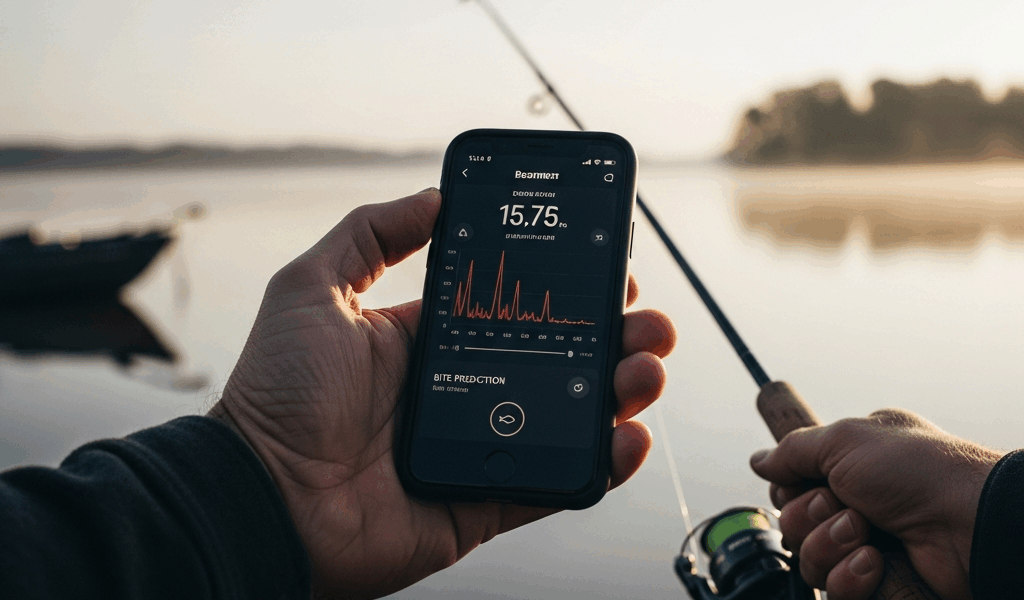
This is the app I use most consistently. It pulls from your phone’s internal barometric sensor on devices that have one — the iPhone 6 and later, most Samsung Galaxy S and A series phones — and displays pressure in hPa, inHg, or mbar depending on your preference. The graph view is the real selling point. You get a rolling 24-hour pressure trend displayed as a clean line chart, which makes it easy to spot whether you’re in a rising, falling, or stable pattern.
What it does well for fishing specifically: the trend line. A single pressure number means almost nothing. Watching that line fall steeply over three hours tells you something real. The pro version adds weather overlays and pressure alerts you can set at custom thresholds — I have mine set to ping me when pressure drops more than 3 hPa in a two-hour window, which is the range where I start expecting active bass.
What it doesn’t do: it doesn’t integrate with fishing-specific data at all. No moon phase, no solunar tables, no species-specific bite predictions. It’s a barometer. That’s it. Which is actually fine, but manage your expectations.
Fishbrain — iOS and Android, Free with Premium at $9.99/Month
Fishbrain is a social fishing app first, but it has barometric pressure integration that’s genuinely useful in context. The app pulls local weather data including pressure trends and layers it against community catch reports from your specific body of water. That combination is legitimately powerful. You’re not just reading a number in a vacuum — you’re seeing what pressure conditions correlated with actual catches reported by other anglers at your lake or river.
Frustrated by generic weather apps that gave me nothing useful for fishing, I started using Fishbrain Premium specifically for the catch-condition correlation feature about two years ago. It’s imperfect — catch reports depend on users actually logging data accurately, and some waters have thin user bases — but on popular lakes it gives you a real empirical picture of what pressure ranges have historically produced fish.
The barometer display itself is less detailed than Barometer Plus. You get current pressure and a basic trend indicator, not a granular graph. Use both apps together if you’re serious about this.
My Fishing Forecast — iOS and Android, Free with $4.99 One-Time Unlock
This app is built specifically around the solunar theory and barometric pressure combined. It gives you a daily bite rating on a simple 1–10 scale, calculated from moon phase, moon position, sunrise/sunset, and local pressure trends. The interface is cleaner than either of the other two apps — a single screen with a bite meter and a breakdown of each contributing factor.
My honest experience with it: the bite ratings are interesting but I stopped trusting the exact number pretty quickly. What I do use is the pressure trend display and the solunar peak times together. When a major solunar period overlaps with a falling pressure window, that’s a legitimate double signal worth getting out of bed early for. When the app shows a “9 out of 10” but pressure is stable-high and it’s the middle of August with 85-degree water temps, I mostly ignore it.
The $4.99 unlock is worth it just to remove the ads. The free version is borderline unusable with the ad interruptions.
How to Use Pressure Readings in Your Fishing
The three scenarios break down cleanly.
Falling pressure is your best window. Fish feed aggressively ahead of a weather system. For bass, this often means topwater and reaction baits — spinnerbaits, crankbaits, surface frogs. The fish are active, moving, and not particularly picky. Get on the water when you see a sharp drop starting and fish fast-moving presentations.
Stable high pressure is the grind. Slow down. Fish bottom presentations, drop shots, finesse jigs. The fish are there but they’re not chasing anything. I’ve had my worst days in beautiful bluebird weather with a 30.20 inHg reading sitting flat for 48 hours. The water is clear, the light is bright, and the fish are lockjawed. Midday during stable high pressure is when I usually go home early and pretend I had other things to do.
Rising pressure after a front passes is a recovery phase. Fish are coming back to feeding but they’re sluggish. Medium-pace presentations, moderate depths, and patience. It can take 24 to 48 hours after a front for fish behavior to fully normalize, especially in clear water lakes. Don’t expect the frenzied bite you saw before the front.
One mistake I made early on: I was checking pressure at home before I left and never rechecking it on the water. Pressure can drop meaningfully over a four-hour fishing session. Barometer Plus running on my phone with the graph open in the background changed how I adapted during a trip.
The Honest Verdict
Barometric pressure affects fish behavior. The science supports it for shallow species. The apps exist and some of them are genuinely useful tools. But here’s the thing — pressure is one piece of a larger picture, and it’s not even the most important piece.
Water temperature matters more for most freshwater species. A 55-degree largemouth bass is going to be slow regardless of what the barometer is doing. Moon phase has a real and documented influence on feeding activity. Seasonal migration patterns, spawn cycles, forage availability — all of these variables have more consistent predictive power than pressure alone.
What pressure does is work as a modifier. Rising temperature plus falling pressure plus major solunar period in the right season equals a genuinely exceptional window. Any one of those factors by itself is interesting. All three together is when I cancel plans and go fishing.
Download Barometer Plus for the detailed graph. Use Fishbrain if your local water has active users logging catch reports. Don’t pay more than five dollars a month for any of this. And stop checking the app every twenty minutes on the water — you’re fishing, not monitoring a weather station.
The bite is out there. Pressure is one of several keys that can unlock it.


Stay in the loop
Get the latest fishing tales journal updates delivered to your inbox.