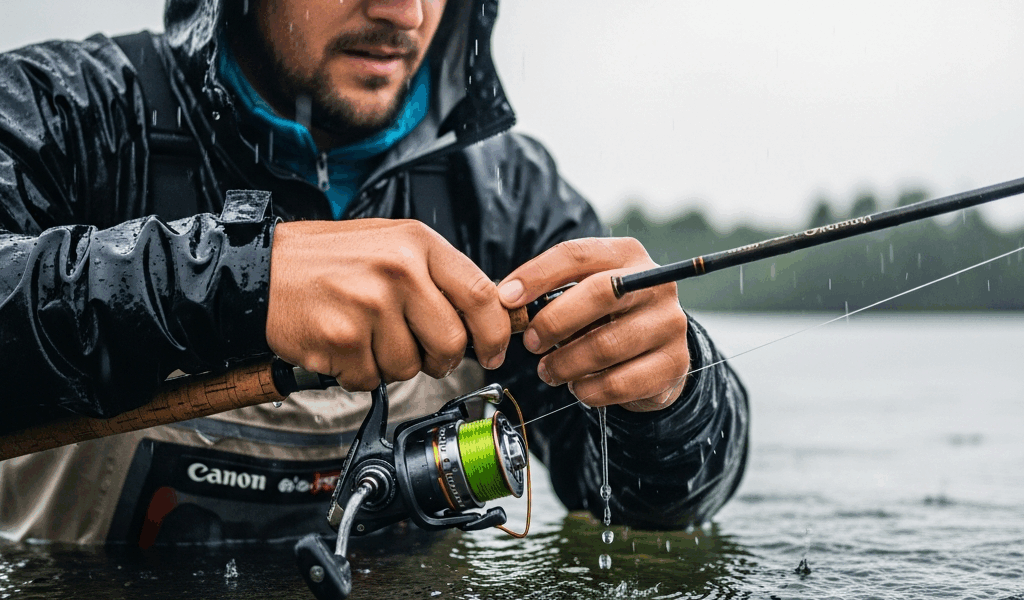
Fishing in the Rain — Why It Actually Improves Your Odds and How to Take Advantage
Fishing in the rain has gotten complicated with all the gear-obsessed noise flying around. Most tips you’ll find online burn three paragraphs on waterproof jacket recommendations before they bother mentioning whether fish are actually biting. I made that mistake for years — showing up cold, underprepared, and fishless, wondering where I went wrong. The gear matters, sure. But it’s a distant second to understanding what rain does to fish behavior. Once I flipped that priority? Rainy days became some of my favorites on the water. Not in spite of the weather — because of it.
Why Rain Often Improves Freshwater Fishing
There are four distinct mechanisms working in your favor when rain arrives. They’re worth understanding separately — they don’t all happen at the same time, and they don’t all hit the same conditions.
Reduced Light Penetration
Cloud cover hammers light levels, and rain hitting the surface creates visual interference that breaks up what fish see from below. Bass that were locked in deep shade during a bright afternoon — holding under docks, submerged timber, sitting in the thermocline — start pushing shallower. That same fish that ignored a surface lure at noon will slide up onto a three-foot flat when the sky goes gray. The water surface becomes a broken, distorted mirror instead of a clear window. Fish that had been cautious become careless.
Surface Noise as Cover
Rain creates continuous broadband noise across the surface. Your footsteps on a gravel bank, your paddle stroke, the clunk of a tackle box lid — all of it gets swallowed up. Fish that would have bolted in dead-calm conditions are just harder to spook. This is especially valuable for bank fishing and wading, where honestly, you’re often closer to fish than you’d ever want to be.
Terrestrial Food Inputs
This one is underrated — genuinely underrated. Rain washes worms, beetles, ants, grasshoppers, and whatever else is living in the soil directly into the water. Fish know this. A smallmouth that’s been sitting in slow current doing almost nothing will start actively feeding the moment runoff begins pushing food into the water column. Earthworms are the obvious one — there’s a reason every kid who grew up fishing was told to dig worms after a good rain — but the insect component matters just as much, especially for trout and panfish near brushy or grassy banks.
Barometric Pressure Drop
Probably should have opened with this section, honestly. The pressure mechanism is the most powerful of the four — and it happens before the rain even shows up. Fish detect pressure changes through their swim bladder, which is sensitive enough to register falling barometric pressure as a weather system rolls in. That detection triggers feeding behavior, hard and fast. The result: the best fishing tied to a rain event often happens in the hours before you see a single drop.
The Barometric Signal — Fish Before the Rain Hits
Check your weather app’s barometer trend — not just the forecast. You’re looking for rapidly falling pressure. A drop of 0.10 inHg or more over a few hours is significant. A front approaching from the west, scheduled to bring rain tomorrow afternoon, can hand you an exceptional fishing window starting that morning or even the night before.
Fish feed aggressively as pressure falls. Hard. The instinct appears tied to anticipating changing conditions — same way you might eat a big meal before a long drive. Once the front fully passes and pressure stabilizes at a low reading, fishing often dies. The fish fed. They’re done. You’re standing in the rain catching nothing, wondering what happened to the bite you had two hours ago.
The practical pattern: if your weather app shows a significant rain event arriving tomorrow, fish today from noon until dark. That window is frequently the best of the entire week. After the front moves through and pressure starts climbing again — usually a day or two later — fishing picks back up. It’s the stable low that kills the bite, not the rain itself.
I once completely ignored a falling barometer on a Thursday — had plans Friday, didn’t feel like it. Drove past a lake I know well on a rainy Saturday morning and watched two guys in a beat-up jon boat absolutely hammering bass near a flooded grass flat. Didn’t stop. Still think about it.
Which Species Respond Best to Rain and How
Not every fish responds identically. Targeting the right species in the right conditions is half the battle.
- Bass (largemouth and smallmouth): Both species push shallower during rain. Largemouth slide into flooded grass edges, dock edges, and shallow timber. Smallmouth work current seams and rocky points. Rain is legitimately one of the best triggers for topwater bass fishing — a Heddon Zara Spook or a Strike King Sexy Frog worked along a grassy bank in light rain will produce strikes that simply wouldn’t happen on a bluebird afternoon.
- Catfish: Rain fishing for catfish is exceptional and weirdly underused. Runoff carries worms and invertebrates into the water, and catfish move to intercept near stream mouths, culvert outflows, and anywhere land drainage enters a lake or river. Cut shad and nightcrawlers on the bottom in those zones. A three-ounce egg sinker, a 2/0 Kahle hook, fresh bait. Simple as it gets.
- Trout: Possibly the best species to target in rain. Insects blown onto the water, hatching activity triggered by changing light and humidity, terrestrial input — it all combines to put trout in an aggressive surface-feeding mode. Dry fly fishing during a steady light rain can be some of the most productive trout fishing of the year. Elk Hair Caddis in size 14 or 16, a Parachute Adams, or a hopper pattern if it’s late summer.
- Panfish (bluegill, crappie): Variable, but light rain moves them toward shallow structure — dock pilings, brush piles in five feet or less, submerged wood near banks. Small spinners and live crickets both work. They’re not as dramatically affected as bass or catfish, but they’re catchable and noticeably more active than on a calm, clear afternoon.
- Carp and suckers: These species go on a genuine feeding binge during and immediately after rain. Runoff carries exactly what they eat constantly — algae, invertebrates, plant matter. If you fish for carp deliberately, a rainy day with runoff entering your water is about as good as it gets.
Technique Adjustments — Before, During, and After Rain
Before the Rain — Pressure Falling
Fish fast and cover water. This is not the moment for slow, methodical presentations. Fish are in an active feeding mode — they’ll move to hit something they’d completely ignore on a neutral day. Run a crankbait along a bank. Work a spinnerbait through shallow brush. Make long casts and keep moving. The fish will tell you where they are fast enough.
During Light Rain
Topwater lures for bass. Dry flies for trout. Natural bottom bait for catfish near runoff zones. The surface disturbance from rain actually helps topwater presentations — lure noise blends with ambient water noise, and fish aren’t inspecting it as carefully. A buzzbait or walking bait retrieved steadily along a bank in light rain is deadly. Slow down slightly compared to the pre-rain window, but keep working structure.
During Heavy Rain
Visibility drops, and fish rely more heavily on their lateral line — the sensory system that picks up vibration and water displacement. Switch to lures with significant vibration or noise. A Colorado-bladed spinnerbait, a chatterbait, a large rattling crankbait like a Rapala Rattlin’ Rap in size 08. Slower retrieves in heavy rain let the vibration do the work. Chartreuse and white combinations hold visibility in stained water far better than natural patterns do.
After Light Rain
Often the best window of the entire day. Fish have been active, the water is slightly cooler and better oxygenated, and you won’t be sharing the bank with anyone who stayed home. Work the same structure you fished during the rain — just slow down. Post-front fish that were feeding aggressively sometimes shift to a more deliberate mode. Still eating. Just not chasing.
After Heavy Rain — Muddy Water
Muddy water changes everything. Clear-water presentations fail. Dark-colored lures — black, dark brown, deep purple — give a stronger silhouette against turbid water than bright colors, which just wash out. Slower retrieves keep the lure in front of fish longer when visibility is measured in inches. Find where cleaner water meets the muddy inflow — a clear tributary entering a stained main lake, or the upstream end of a pool where cleaner water is arriving. Those edges concentrate fish every time.
Flooding Water — The Opportunity and the Hazard
A rising river after significant rainfall can deliver some of the best freshwater fishing you’ll ever experience. It can also kill you. Both things are true at the same time, and neither one cancels the other out.
Fish push into newly flooded margins — grass fields, brush thickets, flooded timber, the bases of riverside trees that were sitting on dry ground yesterday. They’re exploring territory they’ve never been in before, food is washing into those areas, and they’re feeding without the caution they’d show in familiar, pressured water. A bass buried under a flooded hawthorn bush two feet from the bank. A chain pickerel sitting in six inches of water over what was a cornfield last week. The fishing can be extraordinary.
The hazard is real and specific. Current that looks manageable from the bank is often far stronger than it appears. Submerged fences, root systems, rebar — all invisible, all dangerous. Water levels can rise faster than a wading angler can reach the bank. Don’t make my mistake — I once waded into rising current on a flooded creek convinced I had plenty of time, took three steps, felt the bottom shift, and had a genuinely bad thirty seconds getting back to the bank. The rule now: if I cannot see the bottom and confirm footing with every single step, I don’t wade. Full stop.
Fish the flooded margins hard. Fish them from a position where you can actually get out. The fish will be there whether you wade to them or cast from dry ground — and the ones you catch from dry ground are just as heavy.
Rain changes the water. It changes what fish are doing, where they’re holding, and how willing they are to eat. The angler who understands those changes — and shows up with the right techniques rather than just the right rain jacket — consistently outfishes the angler who waited for a sunny Saturday. The jacket still matters. Bring the jacket. But lead with the fishing.
Rain arrives with multiple changing variables; our fishing barometer app guide explains how to log pressure without confusing correlation with causation.

Stay in the loop
Get the latest fishing tales journal updates delivered to your inbox.