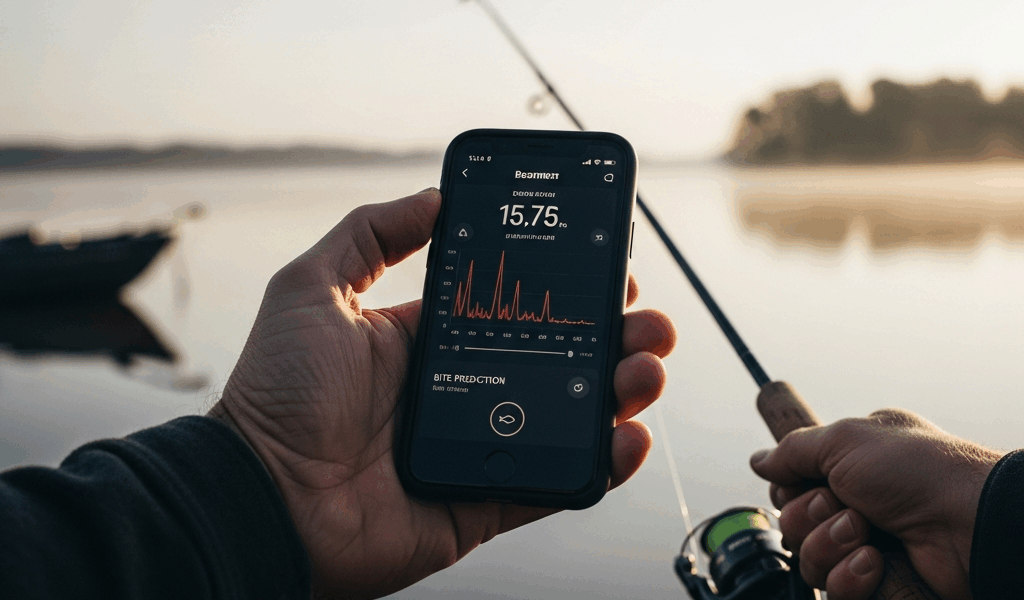
No barometer app can reliably predict whether fish will bite. The useful apps show current pressure, the recent trend, forecast weather, wind and safety alerts, then let you log what happened on your water. Pressure is one weather variable among water temperature, season, light, wind, flow, dissolved oxygen, forage and fishing pressure.
For an all-in-one fishing interface, Fishing Points currently displays barometric pressure and trends alongside weather, solunar and tide information. Fishbrain combines weather and air pressure with catch reports, maps and a fishing log. For anglers who only need weather context, a general forecast service such as Weather Underground can provide pressure and local-station data without presenting a “bite score” as certainty.
App features, subscriptions and free tiers change. Verify the current store listing before downloading; this guide compares documented functions rather than claiming months of testing that did not occur.
Best fishing barometer apps by use
| Need | Useful starting point | Important limitation |
|---|---|---|
| Pressure trend plus fishing forecasts | Fishing Points | Its activity forecast combines models; it cannot know whether fish at your location will bite |
| Catch log, community data and weather | Fishbrain | User reports can be incomplete, delayed, selective or sparse on a particular water |
| Weather and local pressure context | Weather Underground | Not a fishing-specific interpretation tool |
| Most useful personal evidence | Your own log paired with any reliable weather source | Requires consistent entries across many trips |
Can barometric pressure predict fishing?
Pressure often changes with a larger weather system. That same front can change cloud cover, wind, rainfall, temperature, light penetration, runoff, current and dissolved oxygen. An angler who catches more fish before a storm has not isolated atmospheric pressure from those accompanying conditions.
Field observations do not support a universal rule such as “falling pressure always produces aggressive bass.” In one widely cited bass field project, researchers monitored pressure among more than 100 variables and reported no obvious relationship between pressure readings or changes and largemouth or Guadalupe bass behavior. Some observed behaviors differed between high- and low-pressure conditions, but the combined feeding observations did not produce a simple winner.
That does not make pressure useless. It makes it a context and logging variable, not a guaranteed bite switch. Species, depth, season and individual waterbody can change the relationship.
Why the swim-bladder explanation is oversimplified
Many articles say a changing barometer directly expands a fish’s swim bladder and forces it shallow or deep. Fish can detect pressure and regulate buoyancy, but the usual online explanation exaggerates the relative effect of small atmospheric changes compared with hydrostatic pressure produced by depth.
A fish moving vertically through the water column experiences a pressure change. That does not prove a small change in surface air pressure causes a predictable feeding response across bass, trout, walleye, crappie and every other target species.
Use species-specific fisheries research when available. Do not turn a plausible sensory mechanism into a universal lure prescription.
Fishing Points
Fishing Points’ current help documentation lists barometric pressure and trends within its weather section. It also combines weather with solunar, tide and other fishing-planning information. That makes it convenient for checking several trip-planning variables in one interface.
Use it to answer questions such as:
- Is pressure rising, falling or stable over the relevant hours?
- Will wind or precipitation make the intended location unsafe or unfishable?
- Does the tide, flow or water level matter more for this particular fishery?
- What conditions should be recorded in the trip log?
Do not treat a fish-activity rating as measured fish behavior. It is a forecast generated from selected inputs.
Fishbrain
Fishbrain’s current feature pages describe hourly fishing-weather conditions and forecasts. Its app listings include weather, tides, moon phases, wind and air pressure, plus catch logging, maps and community reports.
The strongest use is combining conditions with your own catches. Community data can help generate hypotheses, but it has sampling bias: anglers do not log every unsuccessful trip, locations may be imprecise, and popular waters produce more records than quiet ones.
A high BiteTime score is not a promise. Check the underlying wind, temperature, pressure, daylight and seasonal context, then make an independent decision.
Weather Underground and general weather apps
A general weather service can be the better barometer tool when you do not need social maps or a proprietary bite rating. Weather Underground says its forecasts use neighborhood weather-station data and include pressure among the available observations.
Station quality and distance matter. A phone’s internal pressure sensor may also be affected by elevation changes and calibration. If you drive from a high ridge to a lake, the raw reading changes because elevation changed—not necessarily because a front arrived.
For planning, favor a pressure trend for a fixed forecast location over comparing two uncorrected phone-sensor readings taken at different elevations.
What features matter most?
- Pressure history: a graph is more informative than one current number.
- Forecast pressure: useful for seeing the weather transition, not predicting catches.
- Wind and gusts: often directly affect boat control, casting, drift and safety.
- Radar and alerts: more important than a bite score when storms approach.
- Water-specific data: tide, river level, current, temperature or clarity may dominate.
- Catch log export: lets you preserve and analyze your own observations.
- Location control: ensures the weather source corresponds to the actual water.
- Transparent units: inHg, hPa and millibars should be clearly labeled.
How to read pressure without inventing thresholds
Inches of mercury and hectopascals are different units for the same variable. A change of 0.10 inHg is approximately 3.4 hPa. There is no scientifically established universal threshold at which every target species begins feeding.
Instead, record:
- pressure at the same location and source;
- trend over the preceding hours;
- water temperature and seasonal stage;
- wind speed and direction;
- cloud cover and light;
- rain, flow, water level or tide;
- target species, depth, cover and presentation; and
- effort, bites and landed fish.
After enough trips, compare similar seasons and waters. Seven fish during one falling-pressure trip does not establish causation. Repeated logs can reveal whether a condition is useful for your decisions.
How weather changes fishing tactics
Adapt to observable conditions rather than a pressure number alone:
- Wind may move plankton and forage, create current, reduce visibility and reposition fish.
- Cloud cover can change light penetration and the effectiveness of moving presentations.
- Cold fronts can arrive with temperature, wind-direction and sky changes that affect habitat use.
- Rain can increase flow, turbidity, runoff and dissolved oxygen—or create unsafe conditions.
- Water temperature influences metabolism, spawning stage and available habitat.
Our cold-front fishing guide explains how those conditions interact. The rain-fishing guide covers runoff, visibility and storm safety.
Storm safety outranks the bite forecast
A falling barometer can accompany dangerous weather. Never remain in an exposed boat, on open water, on a pier or under an isolated tree because an app predicts a feeding window. Follow official weather alerts and local boating guidance.
The National Weather Service advises moving to a substantial building or enclosed hard-topped vehicle when thunder is heard. An app’s fishing score is irrelevant during a lightning risk.
A better app-testing method
- Choose one fixed water and target species.
- Use the same weather source for every trip.
- Record unsuccessful trips as carefully as successful ones.
- Track hours fished so catch rate is comparable.
- Avoid changing several major tactics at once.
- Review at least a season of observations before declaring a pattern.
- Do not publish a causal claim from a handful of outings.
Bottom line
Fishing Points is a practical starting point for pressure trends inside an all-in-one fishing forecast. Fishbrain is useful when maps, community reports and catch logging matter. Weather Underground or another reliable general weather service may be enough when you want pressure and storm context without a bite score.
None can reliably predict the bite. Use pressure as one recorded variable, adapt to observable water and weather conditions, and prioritize official safety alerts.

Stay in the loop
Get the latest fishing tales journal updates delivered to your inbox.