Catch and Release Survival Rates — Which Fish Actually Make It?
Catch and release has gotten complicated with all the conflicting advice flying around. Some of them live full lives. Others sink to the bottom an hour later and die quietly where you’ll never see it. The difference between those two outcomes — species, water temperature, what you did in those ninety seconds the fish was out of the water. Let’s get into the actual numbers.
Survival Rates by Species
Not all fish are built the same. Some handle the stress of being caught, handled, and released with genuinely impressive resilience. Others are fragile in ways the science backs up — ways that should probably change how we fish for them.
Bass — The Tough Guys
Largemouth and smallmouth bass are the workhorses of catch and release. Multiple studies from fisheries research programs put post-release survival at 90% or higher under normal conditions. A 2010 study in the North American Journal of Fisheries Management tracked largemouth bass released after tournament fishing — survival rates stayed consistently above 93% when fish were livewell-conditioned before release. Bass regulate oxygen and lactic acid buildup faster than most cold-water species. That said, “normal conditions” matters. Water temps above 85°F start dragging those numbers down.
Trout — The Fragile Ones
This is where things get sobering. Trout survival rates after catch and release run roughly 60% to 85%, and that spread is almost entirely explained by water temperature and how long the fish spent in the air. A rainbow trout released in 55°F water after thirty seconds of air exposure has a genuinely decent shot. That same fish in 70°F water — held up for a two-minute photo — is probably going to die. Rocky Mountain fisheries studies have documented mortality jumping to 30–40% in summer conditions when anglers don’t adjust their behavior. I’ve watched this firsthand on the South Platte in Colorado. August afternoons, low water, fish visibly struggling in the shallows after release, barely moving. Stayed with me.
Pike and Musky — Surprisingly Resilient
Most anglers assume these toothy predators are delicate — big, dramatic fish, surely fragile. The data says otherwise. Catch and release survival for northern pike and muskellunge generally lands between 85% and 95% with proper handling. The real risk factors for pike are jaw damage from improper lip-gripping and prolonged net thrashing. Musky — especially large fish — can experience what biologists call “barotrauma-adjacent” stress from extended fights, but the species recovers well if water temps are reasonable and air time stays short. A Muskies Inc. study from Wisconsin waters found survival above 90% for fish released within sixty seconds of boat-side.
Panfish — Basically Unkillable (Almost)
Bluegill, crappie, perch. These little fish survive at rates above 95% in most documented studies. Smaller fish, lower oxygen demands, shorter fight times, less lactic acid stress. That’s what makes panfish so endearing to beginners and veterans alike — catch and release them without much guilt. They’re fine. They’re almost always fine.
The Three Things That Kill Released Fish
Probably should have opened with this section, honestly. Because once you understand these three variables, the survival rate data above clicks into place pretty fast.
Fight Time
Every minute a fish spends on the line, lactic acid builds in its muscles — same compound that makes your legs burn on a hard run. Fish don’t “breathe hard” to recover from this. It metabolizes slowly. In warm or low-oxygen water, concentrations can hit lethal levels before the fish ever reaches the net. A University of British Columbia study on coho salmon showed mortality increasing roughly 8–12% for every additional minute of fight time beyond four minutes in summer conditions. Use heavy enough gear. Land fish fast. Running 6-pound test on a big brown trout in August isn’t sporting — it’s a death sentence dressed up as a challenge.
Air Exposure
Fish suffocate in air. Not an exaggeration. The threshold most researchers point to is 30 seconds as the target maximum for sensitive species like trout. Beyond 60 seconds, mortality risk increases substantially — regardless of how carefully you handled everything else. Don’t make my mistake. I fumbled with a 22-inch cutthroat on the Green River in Utah once — phone out, trying to frame a decent photo, maybe 90 seconds total in the air. Fish swam off strong. I’ll never actually know if it made it. Bought a GoPro mount for my wading staff the following week. Specific fix for a specific mistake I’m not making again.
Hook Location
A lip-hooked fish and a gut-hooked fish are not the same problem. Studies consistently show lip-hooked fish surviving at rates 20–40% higher than fish hooked in the gills or esophagus. Deep hooking happens most often with live bait, long pauses before the hookset, or small hooks relative to bait size. Set the hook early. Use circle hooks when bait fishing. A 3/0 Gamakatsu circle hook on a nightcrawler gives a fish a real shot at a clean lip hook. A small J-hook with a long wait gives it almost none.
Warm Water vs. Cold Water — The Temperature Rule
Water temperature is probably the single most predictive variable in trout catch and release survival. The number to burn into your memory is 68°F. Above that threshold, trout mortality spikes hard after release — some research puts warm-water trout mortality at 25–40% even with perfect handling technique. The fish are already stressed before you catch them. Low dissolved oxygen, elevated metabolism, compromised immune function. You’re adding insult to injury.
Bass are different. Largemouth living in 80°F impoundments are physiologically adapted to that environment — a bass caught in its thermal comfort zone recovers faster than a trout caught at the edge of its survival range. That’s why the temperature rule is so species-specific. It’s not a universal threshold. It’s a trout threshold.
For trout anglers, the practical application is non-negotiable. A stream thermometer might be the best tool you own, as trout fishing requires real-time temperature data. That is because the difference between 66°F and 72°F is the difference between ethical catch and release and quietly killing fish with good intentions. The Orvis Pocket Thermometer runs about $12 and clips to your vest — no excuse not to have one. Check the water. Above 68°F, stop fishing for trout. Go bass fishing. Chase carp. Take a nap by the river. The fish you’re catching are already fighting the summer.
Early morning fishing in summer isn’t just pleasant — it’s the ethical window. Water temps are lowest after the overnight cool-down. A 5 a.m. start on a tailwater in July can mean clean, defensible catch and release at 62°F. By noon that same stretch may read 71°F. Completely different moral calculation.
Handling Techniques That Actually Matter
Frustrated by years of watching people do this badly at public access points — grip-and-grin photos lasting two minutes, fish held vertically by the jaw, dry hands — I want to be specific about technique rather than vague about principles.
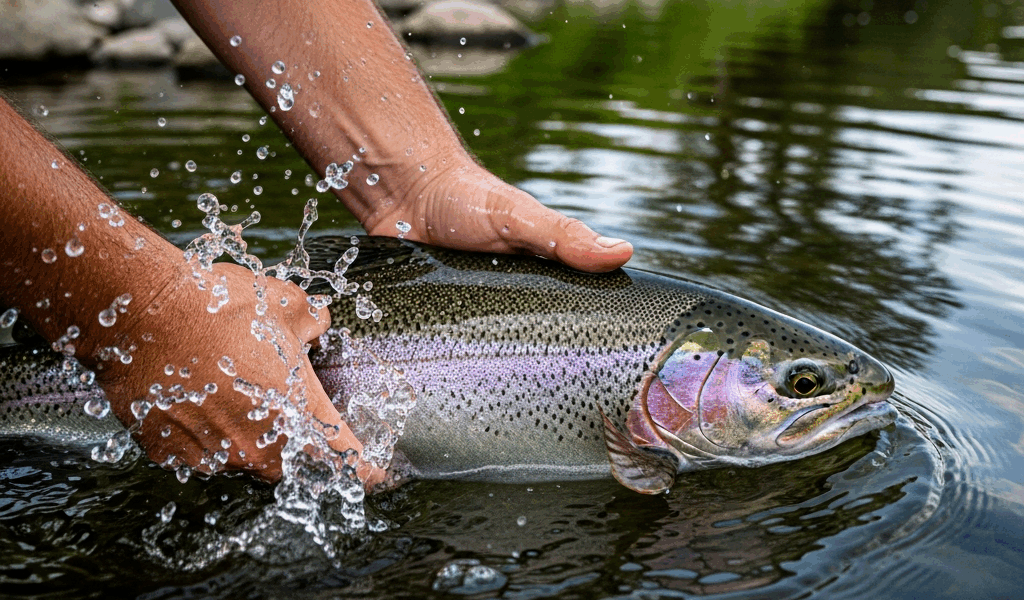
- Wet your hands before touching any fish. Dry hands strip the protective mucus layer — the slime coat — that shields fish from infection. Studies on rainbow trout show measurably elevated post-release infection rates from dry-hand handling. Takes one second. Do it.
- Use a rubber net. Nylon mesh is abrasive and pulls slime coat off at every contact point. Rubber nets — the Fishpond Nomad series runs $80–$130 depending on size — dramatically reduce scale and slime coat damage. Worth every dollar for trout fishing.
- Go barbless or pinch your barbs. Barbless hook removal averages 3–8 seconds. Barbed hook removal can run 20–40 seconds, sometimes requiring forceps and causing real tissue damage. That time difference translates directly to air exposure and stress.
- Keep the fish in the water during hook removal when possible. A submerged fish, hook coming out in 10 seconds with your help, beats a 25-second air extraction every single time.
- Don’t squeeze. Internal organ damage from squeezing is invisible and lethal. Support fish horizontally with two hands — one under the pectoral fins, one near the tail.
- Revive before release. Hold the fish upright in current, facing upstream. Wait until it kicks away on its own. Don’t wave it back and forth — the current does the work. Your job is just to hold it steady.
One product worth mentioning — the Frabill Conservation Series Net ($35–$55) is a solid budget rubber net with a shallow knotless bag specifically designed for quick releases. Genuinely reduces handling damage compared to standard mesh. Not a sponsorship. Just a net I’ve actually used.
When Keeping Fish Is Better Than Releasing
This is the part that doesn’t always make it into catch and release conversations. Sometimes harvest is the more ethical choice. Full stop.
Deep-Hooked Fish
A fish hooked through the gills or esophagus, bleeding visibly, has documented survival rates well below 50% in most studies — sometimes as low as 10–15%. If regulations allow harvest, keep it. A clean kill is better than a slow death on the bottom after a well-intentioned release. That’s not a comfortable thing to type, but it’s true.
Warm-Water Trout Situations
First, you should already know not to fish for trout in water above 68°F — at least if you’ve read this far. But if you’re in that situation anyway and somehow caught one, keep it if it’s legal. A thermally stressed, deeply exhausted fish is better served by a fast death and a good meal than a prolonged struggle to survive conditions it was already failing in.
Stocked Fish in Pressured Waters
Hatchery fish — particularly recently stocked trout in heavily pressured public water — have lower baseline survival rates than wild fish. They haven’t developed the behavioral wariness that reduces recapture, and they often get caught multiple times in a single day by different anglers. Harvest keeps fish off that repeated-stress cycle and is generally within the management intent of the stocking program anyway.
Catch and release is built on genuine conservation values. But those values are served by honest accounting of outcomes — not by reflexive releasing of every fish regardless of condition. The goal is healthy fish populations. Sometimes that means a fish in your cooler instead of back in the water.
Know your species. Know your water temperature. Keep the fish wet, the air time short, the hands wetter. And when the math says a fish won’t make it — be honest about what the ethical choice actually is.

Stay in the loop
Get the latest fishing tales journal updates delivered to your inbox.