The Real Reasons Spinnerbaits Snag More Than They Should
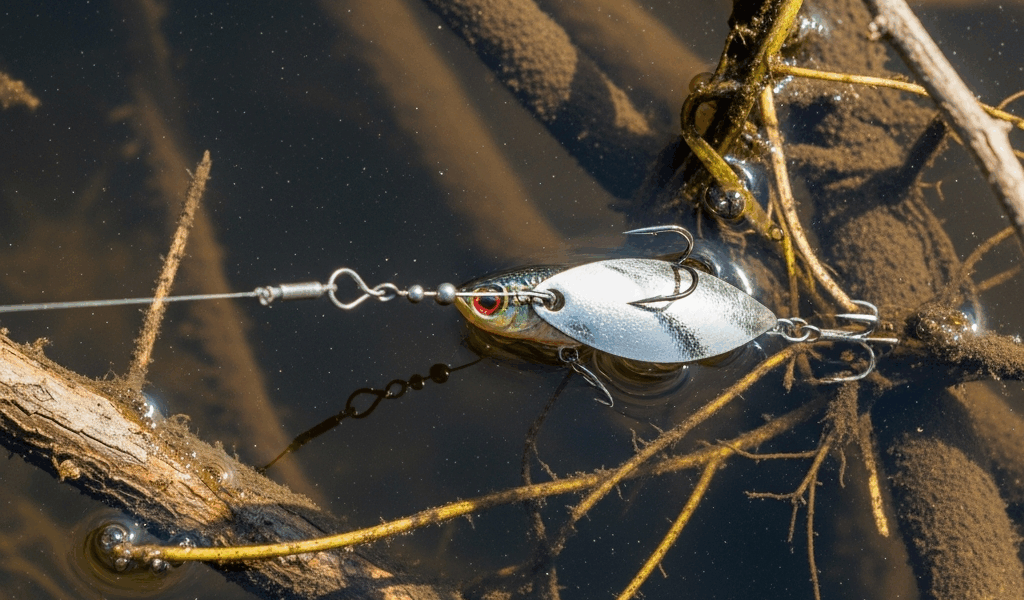
Spinnerbait fishing has gotten complicated with all the conflicting advice flying around. Semi-weedless by design — that’s the whole pitch. Yet here you are, searching for why your spinnerbait keeps snagging on every other cast. Something specific has gone wrong. And honestly, it’s probably not the lure’s fault.
I spent years blaming cheap lures, murky water, bad luck — the usual excuses — before I finally accepted that snagging almost always traces back to one of five things: rod angle during the retrieve, a bent wire arm forcing the blade toward the hook point, casting trajectory, line weight mismatch, or trailer bulk choking the blade’s spin. Most articles skip right past this. They tell you to fish cleaner water and call it a day. Useless advice when you’re standing in front of a laydown at 7 a.m. and your bait keeps diving into the wood every third cast.
So, without further ado, let’s dive in.
Your Rod Angle Is Working Against the Lure
Probably should have opened with this section, honestly. Rod angle alone cuts snags by around 60 percent for most anglers — maybe more.
Here’s what I see constantly on the water: anglers retrieving spinnerbaits with their rod tip low, sometimes pointed nearly straight at the surface. It feels natural. It isn’t. A low rod tip forces the bait to track deeper, nose-diving into bottom debris rather than riding up and over it. The blade can’t deflect structure when the entire head is already pointed at the mud. You’re essentially casting a depth charge and wondering why it explodes on contact.
The fix is mechanical and immediate. Keep your rod tip at roughly 45 degrees during any shallow-structure retrieve — higher if you’re in water under four feet. Over clean bottom or open water, dropping to 10 o’clock is fine. But the moment you’re working a dock, a weed edge, or a laydown, that rod hand comes up to eye level. No exceptions.
What changed everything for me was a specific habit I built in the summer of 2019 on a small reservoir outside of town. I started consciously raising my rod tip at the exact moment of cast completion. Not mid-retrieve — at completion. Before the bait even started moving. After two or three trips fishing that way, my arm just did it automatically. The high-stick position became muscle memory before I realized it had happened.
Don’t make my mistake of spending three seasons blaming your lures before you look at your rod hand.
Wire Arm Bend and Blade Interference Are Killing Your Hooksets
But what is the wire arm actually doing? In essence, it’s a structural guide that holds the blade away from the hook point and keeps the whole system semi-weedless. But it’s much more than that — it’s also the first thing to fail when a fish rolls hard or you rip free of a heavy snag.
When that arm bends even slightly inward, the blade migrates toward the barb. Instead of spinning freely above the hook, it starts deflecting straight into it. Suddenly your semi-weedless bait behaves like a treble hook dragging through mud.
Check alignment before every trip. Hold the spinnerbait at eye level, look straight down the arm. It should run parallel to the hook shank — perfectly straight, no drift toward the point. Any bend toward the hook and you’ve found your culprit.
Re-bending is simple. Grip the head, apply gentle thumb pressure to the arm, work in small increments. Don’t force it. The wire has give, but cheap spinnerbaits — anything under four dollars, frankly — lose that wire integrity embarrassingly fast. I’m apparently hard on equipment, and a $2.99 Strike King I fished heavily for two afternoons came back permanently kinked after about fifteen fish. Replaced it with a Booyah at $6.50 from Walmart and the arm held up through the rest of the season without a single adjustment. That was 2021. I still have that bait.
Check alignment again after every heavy snag or violent fish. One twisted arm can wreck an entire day on the water.
Casting Angle and Entry Point Matter More Than You Think
Frustrated by repeated snags on a dock-lined stretch of shoreline, I started watching exactly where my bait entered the water rather than just casting and retrieving. The problem became obvious almost immediately. I was lobbing the bait straight at structure — vertical entry, hook dropping nose-first into the cover before the blade even started spinning. Once the hook is inside the wood, you’ve already lost. There’s no retrieving your way out of that.
A shallow, parallel approach changes everything. The blade deflects and climbs out of structure instead of burying into it. This new casting habit took hold several weeks later and eventually evolved into the low, skipping entry that spinnerbait anglers know and rely on today for tight-cover situations.
Read the structure before the cast. Targeting a dock? Pick a specific plank or shadow line — the exact point where you want the bait to land. Then use a side-arm or skipping cast to keep the trajectory flat. The bait should hit shallow, skip once, and swim up and away. Aim for a 15- to 20-degree entry angle rather than anything near vertical. Snag rate drops immediately.
While you won’t need a private pond to practice this, you will need a handful of dedicated casts without fishing pressure on your mind. I spent one full evening just casting at dock pilings on a small private pond — no fish, no retrieve, just watching entry angles. About forty casts in, my shoulders naturally dropped into the side-arm position whenever I faced shallow cover. Now it’s automatic.
Quick Checks Before You Blame the Bait
Before you retire a spinnerbait as “snag-prone,” run through this checklist:
- Line weight. Anything heavier than 15-pound monofilament or 30-pound braid can cause the bait to track unnaturally and fight the blade’s deflection — especially in current. If you’re throwing 65-pound braid because you think it gives you more control, you’re actually inviting snags. Drop to 20-pound braid for heavy structure. Seriously.
- Trailer bulk. A thick, chunky trailer can choke blade rotation — blade hits plastic, spin dies, bait sinks. Trim it down or switch to a slim profile. Yamamoto Shad Shapes run about $4 a pack and solve this problem cleanly.
- Retrieve speed. Slow retrieves let the bait sink and nose-dive before the blade engages. Speed up. Keep the blade turning and the lure riding high. In thick cover especially, faster is almost always better.
- Depth relative to structure. Retrieving shallow in ten feet of water creates a line angle that pulls unnaturally upward — the blade can’t deflect bottom snags from that geometry. Match your retrieve depth to where the structure actually sits.
Fix these four mechanical issues — rod angle, wire arm alignment, casting entry point, line weight — and your snag rate drops dramatically. Not because the bait improved. Because you finally tuned the whole system around it.
Stop swapping lures every time you snag. Fix the technique, trust the setup, fish with confidence. That’s how you actually put more fish in the boat.



Stay in the loop
Get the latest fishing tales journal updates delivered to your inbox.