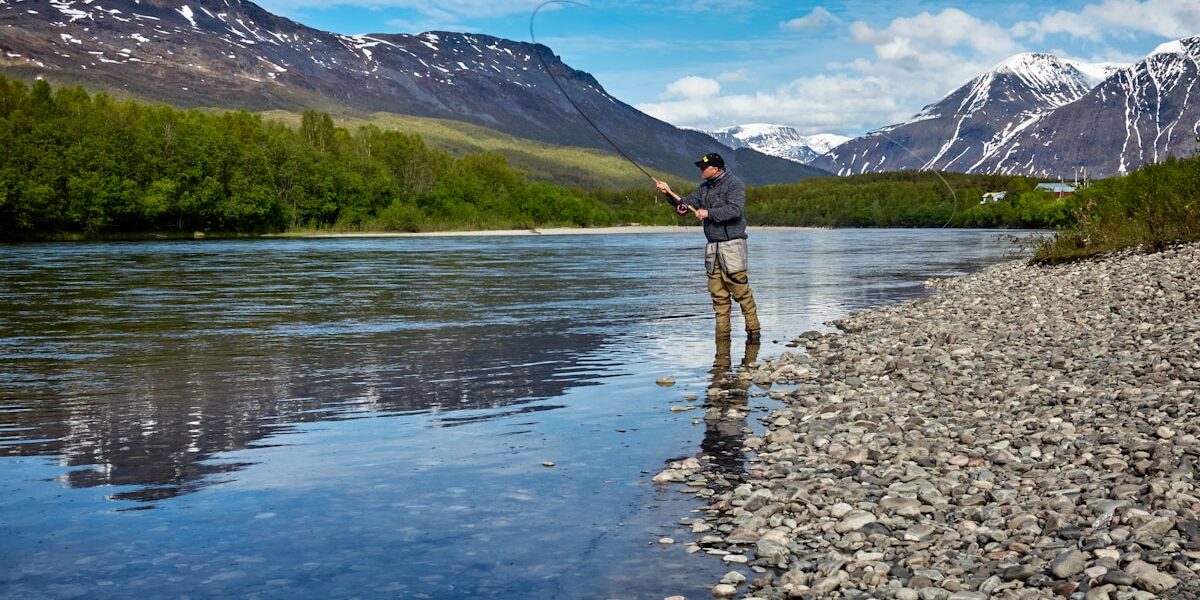
Fishing has drawn in some remarkable people — writers, athletes, politicians, naturalists — and the stories they left behind reveal as much about who they were as anything they said in interviews or wrote about their careers. There’s something about the patience and solitude the sport demands that strips away the public-facing persona. Here are some of the anglers whose stories are worth knowing.
Ernest Hemingway
Hemingway wasn’t casual about fishing — it was a genuine obsession that shaped some of his best work. He spent years in the waters off the Cuban coast pursuing marlin, tuna, and sailfish aboard his boat the Pilar, keeping detailed logs of his catches. The Old Man and the Sea drew directly from those years on the water, and the struggle Hemingway described wasn’t invented — it came from hours in a fighting chair with a large fish on the line and no guarantee of landing it.
His letters to fishing companions describe specific catches with the same precision he brought to his prose: the weight of the fish, the length of the fight, what worked and what didn’t. One trip off Havana produced a marlin he estimated at over 500 pounds that took four hours to boat. He described the exhaustion and satisfaction of it as “the real thing,” which for Hemingway was the highest possible endorsement.
Ted Williams
Ted Williams applied the same analytical intensity to fishing that he brought to hitting. He studied fish behavior and feeding patterns the way he studied pitchers — looking for patterns, finding tendencies, exploiting them. His focus was the Florida Keys, and his specialty was permit and tarpon on the fly, which remains one of the most technically demanding forms of saltwater fishing. Landing a large tarpon on fly tackle requires precise casting, correct presentation, and the ability to fight a fish that can jump six feet out of the water while running line off your reel at 30 miles per hour.
He was famously particular about tackle and technique — he built his own flies, maintained his equipment obsessively, and had limited patience for guides who didn’t understand what he was trying to accomplish. The 150-pound-plus tarpon he landed in the Keys was documented and talked about for years in the local fishing community. His willingness to spend the preparation time that great fishing requires was, characteristically, complete.
Jeremy Wade
Wade built a career out of pursuing fish that most anglers never encounter — species living in river systems so remote and challenging that reaching them was itself a significant undertaking. His goliath tigerfish expedition on the Congo River stands out even in a career full of difficult catches: the Congo is one of the deepest, fastest-flowing rivers in the world, and the goliath tigerfish is an apex predator with teeth that can cut through hardware store wire. Wade spent weeks fishing for one, mostly without success, before finally landing a specimen on camera.
What’s worth noting about his stories isn’t just the exotic locations — it’s the patience. Most of his best catches came after extended periods of failure, adjusting technique, changing location, and refusing to conclude that the fish wasn’t there. I’m apparently more patient than most anglers I know, and I recognize that quality in the way Wade fishes. The fish are usually there. Finding them takes time.
Zane Grey
Grey made his name writing Westerns, but he spent as much time fishing as writing, and he documented his offshore adventures in books and articles that are still readable today. His expeditions were genuinely ambitious — Tahiti, New Zealand, Australia, Baja California — at a time when reaching those places required significant planning and expense.
His grander black marlin in Tahiti — a fish over 1,000 pounds — was the result of weeks of offshore effort in waters that had produced nothing before his party arrived. The fight lasted over four hours. Grey described it in his fishing journals with the same eye for landscape and drama he brought to his novels. His contribution to offshore fishing wasn’t just the catches — it was the documentation, which convinced other serious anglers that those waters were worth the trip. He was, in some ways, the first person to write big-game fishing as literature rather than just as sport.
Lefty Kreh
Lefty Kreh was probably the most influential fly casting instructor of the twentieth century, but the stories that best capture who he was usually involve catching fish rather than teaching. His tarpon fishing in Florida is the most documented part of his fishing life, but he was equally comfortable with a spinning rod or a conventional setup when the situation called for it — which made him unusual in fly fishing circles, where gear snobbery is common.
The story most told about him involves a massive tarpon in the Keys that he located by spotting its shadow on the bottom from a poling skiff. The cast had to land within two feet of the fish without spooking it, and it had to be the right fly at the right depth. He made the cast, the fish took, and the fight went on long enough that his guide was ready to cut the line and go home. Kreh landed it. His patience during the fight and his calm during the cast were what made him Lefty Kreh.
Lee Wulff
Wulff’s contribution to fishing wasn’t primarily his catches — it was what he argued about them. His most famous line, “a game fish is too valuable to be caught only once,” was a challenge to the prevailing culture of the mid-twentieth century, when keeping everything you caught was the norm and catch-and-release was considered eccentric. He was right, and his advocacy helped shift the conservation ethic of recreational fishing in ways that are still visible in current management philosophy.
His trip to the Miramichi River in New Brunswick — where he documented Atlantic salmon returns and argued for protecting the species — is worth knowing about specifically because the Miramichi salmon fishery is still functioning today, partly because of the conservation arguments Wulff made in the 1940s and 50s when there was still time to matter.
Kevin VanDam
VanDam’s story is different from the others on this list — he’s a competitive professional rather than a naturalist or literary figure — but the 2010 Bassmaster Classic is genuinely worth knowing about as a piece of fishing history. He came into the final day of competition needing to catch a specific weight of fish just to stay in contention, and he proceeded to catch 25+ pounds while other anglers were posting single-digit days. The margin of victory was over 15 pounds in a tournament where fractions of a pound usually separate competitors.
What made it notable wasn’t just the weight — it was the decision-making. VanDam had found a productive area early in the tournament and committed to it completely on the final day when other anglers hedged by covering more water. The discipline to fish one area when the fish are actually there is harder than it sounds when the pressure is on and they’re not biting immediately.
Izaak Walton
Worth ending with the oldest name on the list: Walton’s The Compleat Angler was published in 1653 and has never gone out of print, which is as strong an endorsement as a fishing book can get. It’s not really a technical manual — it’s more of a pastoral dialogue about the pleasures of a fishing life, set against the English countryside and written during a period of considerable political turmoil in England.
What makes it endure is the argument it makes, which still holds: that fishing is primarily a way of being in the world rather than a method of catching fish. The specific techniques are mostly obsolete, but the attention to place, weather, season, and the natural world around the angler is as relevant now as it was 370 years ago. That’s what makes fishing endearing across generations — the fundamentals of why people go don’t change much, even when everything else about how they do it does.

Stay in the loop
Get the latest wildlife research and conservation news delivered to your inbox.