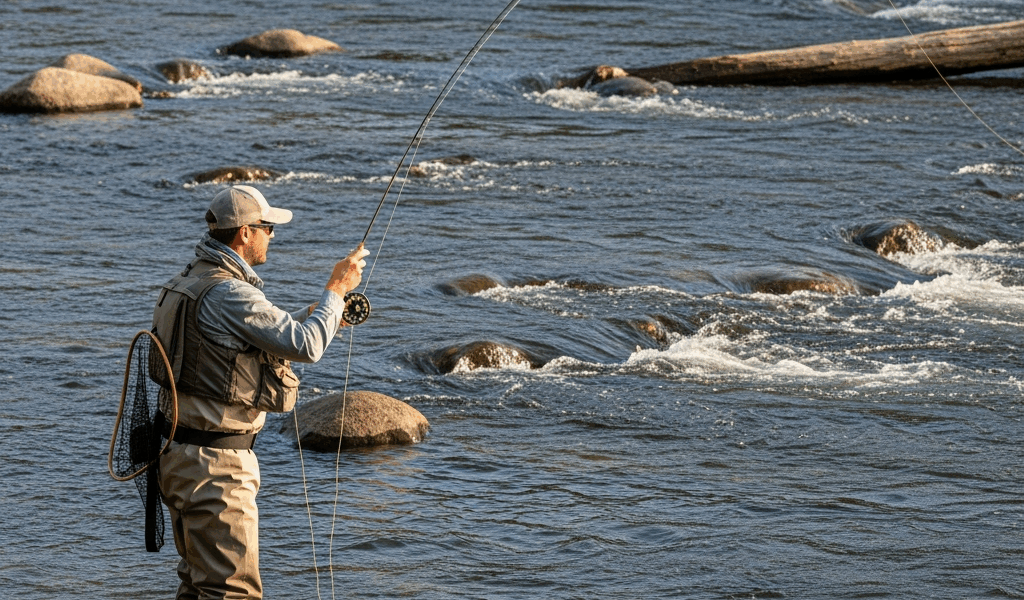
Where Do Fish Hold in Rivers — A Visual Guide to Reading Water
River fishing has gotten complicated with all the gear advice and technique noise flying around. They’re where the water does something — changes speed, deflects off a rock, bends around a gravel bar. Learning to read those features before you ever wet a line is the skill that compounds. Everything else — tackle, flies, lures — is honestly secondary to this.
This guide breaks down river holding water by current type and then by species, because trout and smallmouth bass don’t read the same current the same way. That difference is what gets you dialed in faster on unfamiliar water.
The Three Current Zones Every River Has
Every river section — no matter how chaotic it looks from the bank — organizes itself into three current zones. Train your eye to see these zones and you stop looking at a river as one confusing piece of water. You start seeing a map.
Fast Water
Fast water is the main push. The tongue of current carrying the most volume, moving the most surface debris. You’ll find it in the center of straight runs, at the head of pools where the gradient drops, and squeezing through any narrow channel between rocks or banks. High-energy water. Fish can hold here — but only if there’s a structural reason. A boulder deflecting current. A depression in the streambed. A ledge that lets them sit just below the main push without burning calories they can’t afford to burn.
Standing in fast water costs fish energy. The ones you find holding there are usually tucked into a tiny pocket of cushion water on the upstream face of an obstruction — almost stationary, in a little calm pocket, while food rockets past them on both sides.
Seams
But what is a seam? In essence, it’s the boundary line between fast water and slow water. But it’s much more than that. Visually, it shows up as a slight crease on the surface — sometimes a line of foam or debris tracking the current differential. A seam is a conveyor belt. Food gets swept along by fast water, hits the break, and collects right there. A fish sitting on the slow side can dart into the fast water, grab something, and return to its holding position with minimal energy spent.
I’ve spent a lot of time staring at seams before casting. Here’s what I eventually learned the hard way — most anglers drop their fly or lure into the fast water and drag it across the seam. That’s backwards. The fish is sitting in the slow water, watching the fast water. Your presentation needs to land in the fast water and drift naturally into the seam, not fight its way across it. Don’t make my mistake.
Slack Water
Slack water is the low-energy zone — back eddies, pool tails, wide flat sections downstream of a major feature. Fish use slack water differently depending on species and season. During active feeding, you won’t find fish sitting in pure slack most of the time. They’ll be at the edge where slack meets seam. In cold temperatures, though, when metabolism slows way down, slack water near depth is where fish park themselves and wait out the cold. Worth noting: slack water adjacent to a feeding lane is prime real estate. Pure slack with nothing nearby is usually empty water.
Reading Current for Trout
Trout fishing in rivers is fundamentally a current-reading exercise. These fish are hardwired to face upstream, hold in the most energy-efficient position available, and let the current deliver food to them. Their holding spots reflect that biological reality in very specific ways.
Current Seams and the Upstream Face
Probably should have opened with this section, honestly — this is where most trout are most of the time. The upstream face of any obstruction — a boulder, a log, a bridge piling, even a change in streambed composition — creates a cushion of slower water. Current splits around the obstruction, and directly in front of it sits a low-pressure zone. Trout hold there with their nose pointed upstream, almost stationary, in water that feels like nothing while current thunders around them on both sides.
On smaller streams I’ve waded in Vermont, a fish sitting four inches in front of a softball-sized rock in 18 inches of water is invisible until it moves. That’s the spot. Not behind the rock. In front of it. Every time.
Feeding Lies vs. Resting Lies
Trout have two modes — feeding and resting — and they often hold in completely different spots for each. A feeding lie is on or near a seam where food gets delivered. A resting lie is deeper, slower, usually in the pool itself. During a hatch, trout slide out of the depths and up onto feeding lies along the seams. After the hatch, they drop back down. If you’re fishing between hatches and the surface is dead quiet, fish the depth. If there’s surface activity anywhere on the run, fish the seams first.
After getting skunked on a run I’d worked for a solid hour one morning on the Battenkill — I was casting to all the wrong water — I finally started marking where I first saw fish move. Almost always the same three or four seam positions, regardless of conditions that day. That observation alone changed how I approach unfamiliar water. I look for seam positions first and trust that trout are sitting in or near them.
Tailouts
The tailout of a pool — where depth gradually shallows and water starts to accelerate back into fast water — is a feeding trap. Food suspended in the pool gets funneled and concentrated as the water narrows and speeds up. Trout sit at the top of that acceleration zone and intercept it. In low light especially, bigger fish move into tailouts. This is a feature most newer anglers walk right past on their way to the pretty-looking pool head upstream. That’s a mistake worth correcting early.
Reading Current for Smallmouth Bass
Smallmouth bass in rivers are a different animal than trout. More aggressive in their holding behavior, more willing to move and chase food rather than waiting for it, and they use current features with a different logic entirely. That said, they’re still energy-efficient by nature — they just have a higher tolerance for current, and they use structure to ambush rather than intercept drift.
Eddies Behind Boulders
If there’s one feature that defines smallmouth holding water in rivers, it’s the eddy behind a large boulder. The downstream side of a rock creates a circulation — water gets pulled back upstream in a reverse current, forming an oval of slack water directly behind the obstruction. Smallmouth sit in that eddy facing downstream — toward the reverse current, not upstream like trout — watching for anything getting swept along the seam line around the boulder.
On the New River in Virginia, I’ve watched smallmouth in gin-clear water, sitting perfectly still in eddies behind rocks the size of a washing machine — just hovering there, facing downstream. When I switched from an upstream presentation to casting downstream and swinging a Strike King Rage Swimmer — 3/8 oz, chartreuse — along the seam edge of the eddy, it was like fishing a different river. Fish on nearly every cast in spots I’d been completely ignoring all morning.
Current Breaks at Depth Changes
River smallmouth also use changes in depth the way trout use seams. Where a flat shelf drops suddenly into deeper water, there’s a current break right at the edge. Faster, shallower water sweeps baitfish over that lip. Smallmouth sit at the bottom of the drop — almost directly below the shelf edge — and ambush whatever comes over. This is subsurface and harder to read visually, but if you see a defined depth change, even a 14-inch drop from flat to a deeper run, it’s worth a few casts worked slowly along the bottom edge of that transition.
3 Current Features That Always Hold Fish
Regardless of species, three river features produce fish with enough consistency that I never walk past them without making a few presentations. Never.
Confluence Points
Where two currents meet — a tributary joining the main river, or two channels rejoining after splitting around an island — you get a mixing zone. Food concentrates from two directions at once. The seam between the two currents is almost always productive. The temperature differential between a cold tributary and a warmer main river also stratifies fish, especially in summer — trout stacking tight to the cold water entry. They look chaotic, but they organize fish in completely predictable ways.
Inside Bends
Rivers cut into their outside bends and deposit gravel on their inside bends. That inside gravel bar creates a shallow, slow-water environment sitting right next to a deep outside-bend pool. The seam between those two is a feeding lane — fish hold in the depth of the outside bend and move up onto the inside seam to feed. Targeting the transition between shallow gravel and the deeper outside current, especially at first and last light, consistently puts fish in the net. This is one of those spots that looks too simple to be that good. It really is that good.
Tailouts — Again, Because They’re That Good
Worth repeating here for both species. Tailouts are where pools evacuate their food supply — every pool has one, and most anglers walk right past them. The acceleration zone at the downstream end creates a concentration effect that both trout and smallmouth use hard. In rivers I fish regularly, tailouts account for a disproportionate share of fish — maybe 40 percent of fish from 20 percent of the water. Apparently that ratio alone should tell you where to spend your time, but somehow it takes most of us years to figure that out.
Reading river current is a skill built over water time — not over one article. But the framework here — three current zones, species-specific holding behavior, and those three structural features — gives you a working map for any new piece of river you step into. Start with the seams. Find the eddies. Never walk past a confluence or a tailout without making a cast. The fish will confirm or correct everything else.


Stay in the loop
Get the latest fishing tales journal updates delivered to your inbox.