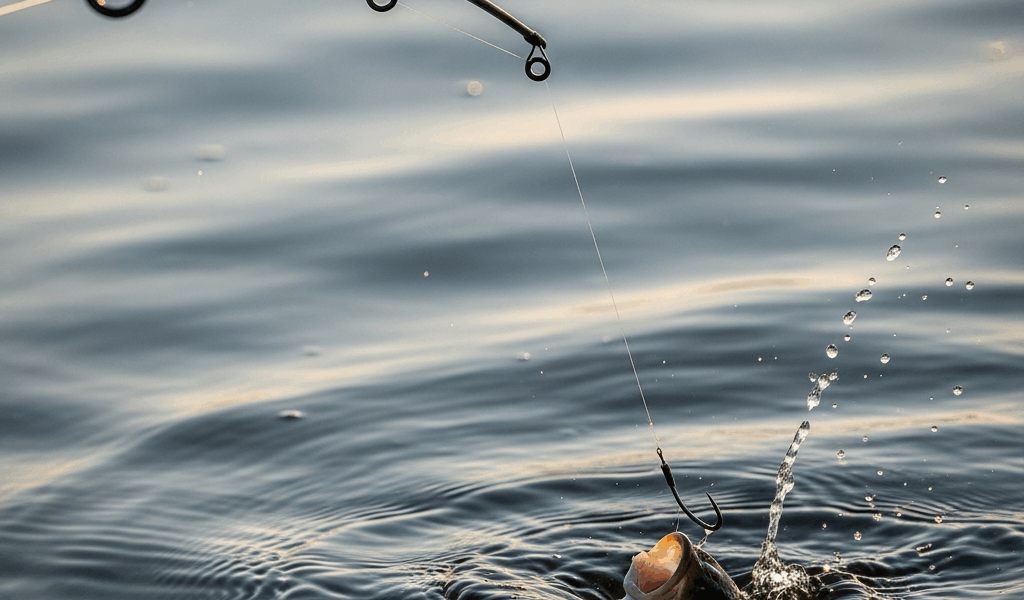
You Are Getting Bites But Not Catching Fish
Missed strikes have gotten complicated with all the vague “set faster, set slower” advice flying around. That tap on the line. That unmistakable tick through the rod. Then nothing. Hook comes back clean, and you know something was there — you felt it.
I spent two full seasons blaming my reflexes. Turns out the problem wasn’t slow hands. It was that I kept treating every missed strike as one problem when it’s actually three completely different problems wearing the same disguise. Don’t make my mistake.
the actual diagnosis, not just a list of guesses. Timing. Hook size. Rod and line mechanics. Each one requires a different fix, and mixing them up is exactly why most anglers stay stuck.
Your Hook Set Is Coming Too Early or Too Late
Set too fast and you rip the bait away before the fish’s mouth closes. Set too slow and the fish ejects it on its own terms. That’s what makes this so maddening — “too fast” and “too slow” feel completely identical when you’re running on instinct.
A feeding strike and a reaction strike are different animals. A largemouth bass crushing a topwater plug commits hard — mouth open, head down, line screaming. Set immediately. A crappie nibbling a live minnow barely loads the line. Wait two full seconds. Sometimes three. A catfish mouthing chicken liver will drop it the instant you jerk early.
Most anglers use the same timing for every lure, every species, every situation. That doesn’t work. It never worked. It just occasionally gets lucky.
Soft plastics demand patience. A bass picking up a 4-inch Senko off the bottom needs time to turn its head and work the bait toward its throat. I learned this on a lake outside Jefferson City, Missouri — missed six consecutive strikes before a local guide told me to count one beat before setting. Not a full second. Just a beat. Those six missed fish turned into six hooked fish on the next pass. Same spot, same bait, one small adjustment.
Live bait requires even more patience. The fish tastes it, feels it, decides whether it’s safe. Two to three seconds isn’t excessive — it’s necessary.
Hard lures are the exception. A crankbait or spinnerbait is already inside the fish’s mouth when you feel it. Set immediately when you feel weight. No counting, no pause.
Watch your rod tip more than your clock. If it’s still straight, the fish hasn’t loaded the line — wait. If the tip bends and stays bent for half a second, that’s your cue. Braided line telegraphs the strike faster. Monofilament softens it, so your patience window needs to stretch a little wider to compensate.
Your Hook Size Does Not Match Your Bait or Target Fish
But what is a mismatched hook, really? In essence, it’s any hook that changes how your bait moves or behaves in the water. But it’s much more than that — it’s also a structural problem that either collapses under pressure or broadcasts “fake” before the fish ever commits.
Oversized hooks telegraph the whole rig. A panfish bait rigged on a 3/0 when a 1/0 belongs there looks stiff, moves wrong, and reads as artificial to every cautious crappie in the area. The fish investigates out of curiosity. Then it rejects it. Your hook never gets near the corner of its mouth.
The other direction kills bigger fish. A light wire hook on a 7-pound bass might achieve initial penetration, but the second that fish runs or head-shakes, the hook bends open. You feel the strike. The fish just feels pressure — then slides free. Happened to me twice in one morning on Table Rock Lake before I figured out what was going on.
Match hook size to bait size first. A 2-inch worm takes a 2/0 or 3/0. A 4-inch worm takes a 4/0 or 5/0. A live bluegill minnow on a jig head calls for a 1/0 or 2/0. As a general rule, the hook eye shouldn’t exceed half the bait’s depth once it’s rigged up.
Match hook strength to target species second. Crappie, bluegill, perch — these fish live on smaller hooks with thinner wire. They don’t need much pressure to set. A 32-count pack of size 6 Aberdeen hooks runs about $3 at any bait shop and handles panfish all day without issue. Bass and pike are different. They hit hard, run harder, and will absolutely straighten light wire on a strong hookset. A 2/0 or 3/0 offset shank hook in carbon steel — something like the Gamakatsu EWG offset worm hook, around $5 for a 10-pack — handles serious pressure without flexing. That $2 difference per pack is meaningless compared to the fish you’ll lose using the wrong one.
Circle hooks deserve a mention here because they change the math entirely. A circle hook doesn’t need an aggressive set. The fish’s own head turn seats the hook automatically. For catfish, live bait walleye, or any slow passive presentation, circle hooks eliminate the timing problem almost completely. They don’t work well on hard lures or when you’re fishing aggressively — but as a diagnostic shortcut for missed live bait strikes, they’re hard to beat.
Your Rod and Line Are Absorbing the Hook Set
Probably should have opened with this section, honestly. A bad rod can ruin perfect timing and a properly sized hook in a single motion, and most anglers never suspect the equipment.
Fast-action rods — the kind that bend mostly in the upper third — convert your arm movement into direct force at the hook. Slow-action rods bend along their full length and absorb that energy like a shock absorber. For hook sets, fast action wins. It’s not really a debate. I’m apparently a medium-fast guy, and a St. Croix Avid in 7-foot medium-fast works for me while slower composite blanks never seem to connect cleanly on soft plastic bites.
Line choice matters just as much. Braided line has almost zero stretch — 10-pound Power Pro braid, for example, transfers your set energy almost instantly. Monofilament stretches considerably. A 3-foot stretch in 20-pound mono from 30 feet out means you’ve burned roughly 15 percent of your hook set energy just pulling line tight before the hook ever moves.
Here’s the mechanical detail most anglers miss entirely — slack kills every set. A bow in the line from current, wind, or a lazy cast means the first half-second of your hook set just removes slack. Force doesn’t reach the hook until the line goes straight. By then, the fish has already felt the odd pressure and started ejecting.
Tighten your drag enough that the line doesn’t slip under a hard set. Not so tight that you risk snapping the line, but enough to maintain real tension. If your set feels mushy, either there’s slack in the system or the rod is eating the energy. Reel down first to eliminate slack. Still feels soft? That’s your rod talking.
Quick Checklist Before Your Next Trip
Missed strikes are data. Every single one tells you something specific if you’re paying attention. So, without further ado, let’s dive in — three questions, that’s all this takes.
- Am I setting at the right moment? Count the pause. Test different timings on the next dozen bites. One of them will convert — and when it does, you’ll know exactly what to repeat.
- Is my hook sized right for this bait and this fish? Downsize and go thinner wire for panfish and light presentations. Upsize and go carbon steel for bass, pike, and anything that fights hard.
- Is my setup transferring the hook set, or absorbing it? Check for slack first. If everything is tight and the set still feels soft, look at your rod action and consider switching from mono to braid on your next spool.
That’s it. Isolate the cause, test the fix, and adjust. The strikes were always there — now you’ll actually land them.


Stay in the loop
Get the latest fishing tales journal updates delivered to your inbox.