The Real Reason Rod Tips Break More Than Any Other Section
Rod tip breakage has gotten complicated with all the bad advice flying around about drops, accidents, and cheap manufacturing.
That last break hurt the most — a $200 blank, suddenly worthless from the ferrule up, because I’d been doing something wrong for months without realizing it. The tip section is thinnest. It flexes the most. It has the least material absorbing stress. Physics is working against you from day one. But most breakage isn’t inevitable. It’s preventable.
People blame drops. Bad luck. Cheap guides. Those happen, sure. But the real culprits are storage habits, casting angles, and wear patterns that creep up over months without announcing themselves. That’s what makes this problem so frustrating to anglers who consider themselves careful — they’re doing invisible damage without knowing it. That part is fixable.
Casting Lures Too Heavy for Your Rod Rating
Every rod blank has a lure weight range stamped near the handle. Mine says 1/8 to 5/8 ounce — medium-light spinning, Shakespeare Ugly Stik GX2. That number isn’t a loose suggestion. It’s the threshold where micro-fractures start forming inside graphite.
But what is a micro-fracture, exactly? In essence, it’s a tiny structural crack invisible to the naked eye. But it’s much more than that — it’s cumulative. One heavy cast doesn’t snap anything. Neither do five. Each overloaded cast deposits a little more damage, invisibly, until a completely routine cast finishes the job.
Probably should have opened with this section, honestly. I spent an entire spring throwing a 3/4-ounce lipless crankbait — a Rat-L-Trap, specifically — on what I assumed was a medium rod. Turned out it was a medium-light rated for 1/4 to 1/2 ounce. The tip went on a routine cast into a weed bed. No snag. No drop. Just cumulative stress finally winning after about sixty casts too many.
To find your actual rating, look at the blank within six inches of the handle. Two numbers, separated by a dash or the word “to.” If it’s worn off, contact the manufacturer with your model name — most brands keep serial number records and will email you the spec sheet. Don’t make my mistake. Once you know your range, respect it. Occasional slight overloads won’t kill a rod. Repeated heavy casting absolutely will.
High-Sticking and Fighting Fish at the Wrong Angle
High-sticking is holding your rod nearly vertical while a fish pulls. Tip pointed skyward. Full line tension loading directly into that thin, vulnerable section instead of distributing across the mid-blank where the rod is actually strongest.
Keep the rod below 45 degrees when a fish is running hard. That angle lets the whole blank work — not just the tip. At 45 degrees or lower, load distributes across multiple sections of graphite. At vertical, it concentrates at the thinnest point. Simple geometry, brutal consequences.
This mistake happens in exciting moments. A big largemouth hits and your instinct says lift hard. That’s high-sticking. A catfish drags sideways and you raise the rod for leverage. High-sticking again. I’m apparently a slow learner on this one — I did it constantly as a younger angler, convinced vertical pressure meant better hookset power. It actually meant shorter equipment lifespan and a tip section working well outside its design parameters.
Keep the rod working the way it was built to work. Don’t just hold the tip up and hope.
Storage and Transport Mistakes That Crack Tips Slowly
Most rod damage happens between fishing trips, not during them.
Rods leaning against truck bed walls. Tips rolling loose in a back seat with tackle boxes piling on. Hooks looped through the tip guide during transport instead of through the keeper on the handle. I’ve done all of these — sometimes all on the same trip.
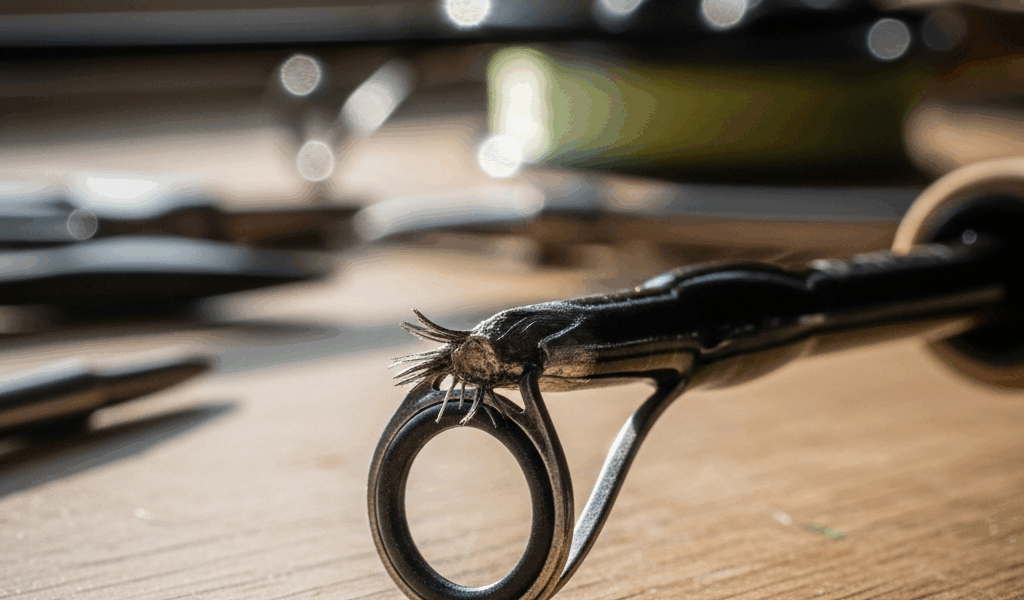
The tip-top guide — that tiny ring at the very end — is particularly fragile. When a hook sits in that guide during a two-hour drive, the hook weight puts constant pressure on it. Every pothole, every quick turn, every highway expansion joint compounds the stress. The guide cracks or chips. The tip section develops micro-fractures from sustained pressure alone. You don’t see it happen. You just notice one day that something feels wrong.
Rod bags help, but a crammed or rigid case creates its own problems. Cheap neoprene sleeves let rods shift against each other. Premium hard cases with inflexible internal walls can press against the tip section for hours — pressure points that eventually cause stress fractures. Not obvious. No immediate visible damage. Just slow, steady degradation.
Here’s what I do now: vertical rod holders in my truck bed — a $28 set from Amazon, RAM Mounts compatible — so tips point up and nothing rests on them. Hooks always go through the handle keeper, never the tip guide. Takes thirty extra seconds and prevents months of invisible damage. That’s what makes this fix so endearing to anglers who hate replacing expensive equipment.
How to Check Your Rod Tip for Hidden Damage Before It Snaps
So, without further ado, let’s dive in — because this inspection takes about four minutes and most people skip it entirely.
Run a cotton ball slowly through each guide, starting near the handle and working toward the tip. Any catch or snag means a crack or chip inside the guide ring. You’re feeling for roughness that would fray fishing line over dozens of casts. This catches corrosion and damage long before you’d spot anything visually — a $0.50 cotton ball doing the work of a $200 rod replacement.
Eyeball the tip-top guide specifically. Look for discoloration, rust, or white chips in the coating. A magnifying glass helps — I use a $12 jeweler’s loupe I keep in my tackle bag. Corrosion weakens the guide. Chips turn into cracks. Either one transfers stress directly into the tip blank during every cast.
Gently flex the tip by hand. Cup the end and pull it down slowly and smoothly. A healthy tip bends in one continuous curve. A cracked or compromised tip might show a flat spot, a kink, or a section that feels stiffer than the surrounding material. Trust what your hands tell you — the difference is obvious once you’ve felt it.
Catch damage early and a tip repair kit fixes it. Around $15 to $40 depending on rod diameter — Fuji and American Tackle both make reliable kits. You remove the damaged tip-top, slide a replacement on, secure it with two-part epoxy, and wait an hour. The rod is back in service. If the blank itself is visibly cracked or flexes wrong, replacement makes more sense. A damaged blank fails repeatedly — sometimes the rod is simply done.
Check quarterly, minimum. Most of this damage is completely preventable with basic awareness and thirty seconds of proper storage habits. Your rods will last years longer. Don’t make my mistake — by the time I understood all of this, I’d already paid for three tip repairs I never needed to make.



Stay in the loop
Get the latest fishing tales journal updates delivered to your inbox.