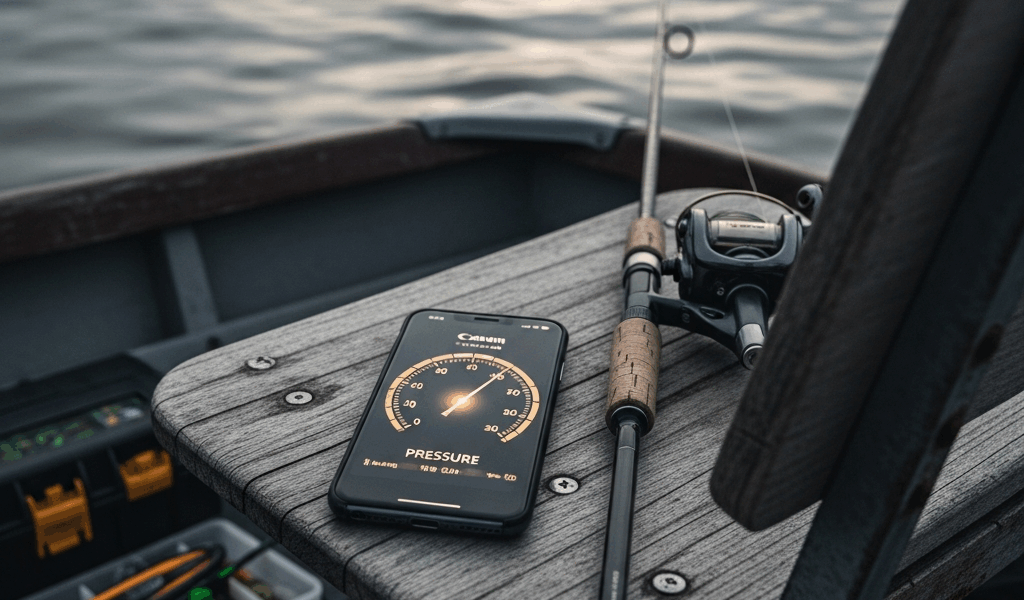
Barometric Pressure and Fishing Has Gotten Complicated With All the Conflicting Advice Flying Around
As someone who spent three months obsessively tracking barometric readings across a Minnesota lake and a smallmouth river in Missouri, I learned everything there is to know about whether any of this pressure stuff actually matters. Spoiler: it does. Just not the way the forums tell you.
I went in skeptical. Fishing forums treat pressure readings like sacred text. Apps promise bigger catches if you check the numbers at exactly the right moment. What I actually found was messier — and more useful — than any of that.
The absolute number means almost nothing. 30.12 inches of mercury. 29.85. Neither one tells you what to do. What matters is the trend. The direction. How fast the needle’s moving.
Probably should have opened with this section, honestly, because it would have saved me weeks of confusion. Falling pressure is your window. When the barometer drops, fish feed aggressively — they know something’s coming, they eat harder, and they commit to bites instead of just nosing at your lure. I caught seven bass in ninety minutes during a pressure drop one Saturday afternoon. Wind picking up, sky going dark, fish absolutely frantic. That’s the window you want.
Rising pressure? Fish move shallower and get harder to trigger. Stable high pressure is the worst of all — no predators incoming, no prey fleeing, fish with zero reason to move. The fishing turns patient and methodical. Tough, honestly.
The rate of change matters too. A slow drift downward produces different behavior than a rapid plunge. My notes from twelve weeks of outings showed a real difference between a drop of 0.08 inches per hour versus 0.15 inches per hour. Faster drop, more decisive bites. Slow drift, more selective fish. That distinction took me about six weeks to notice.
Best Free Barometric Pressure Apps for Fishing — What Actually Works
I tested three free apps head-to-head over twelve weeks. Not just opening them once and forming an opinion — I checked each one at the same times daily, on the same water, under similar conditions. Some tracked trends accurately. Some just handed you a number and called it a day.
FishBrain
But what is FishBrain? In essence, it’s a social fishing app that happens to include a barometer feature. But it’s much more than that — for logging catches and learning local patterns, it’s genuinely solid. For pressure-specific decisions, though, you hit a wall fast.
No historical trend data. No forecast integration. No “pressure dropping 0.3 inches in the next six hours” type predictions. You get right now. That’s it. I used it as a companion app — never a primary resource. The catch-logging features kept me coming back, but I wasn’t making any fishing decisions based on its pressure data alone.
Fishing Points
Fishing Points offers something FishBrain doesn’t: a small historical graph. Past day or two of pressure movement — enough to tell you whether things are trending up or down. The interface is clunky. Genuinely difficult to read at first glance, and I spent an embarrassing amount of time trying to figure out what I was looking at.
The free version shows basic pressure data with a thumbnail chart. Premium runs $2.99 per month — around $30 annually — and adds more detailed forecasting. I upgraded for one month just to see if it was meaningfully different. It is. But you can get close to the same outcome by checking the free version twice daily and keeping your own mental notes. I did exactly that for three weeks before bothering to upgrade.
Weather Underground
This one surprised me. Weather Underground is not a fishing app — it’s general weather — but it has one advantage the fishing-specific tools don’t: accurate, detailed barometric pressure data with six-hour forecasts built into the free version.
No solunar index overlays. No fishing-specific alerts. Nothing with a fish icon anywhere on the screen. But as a pure pressure-tracking tool, it outperformed FishBrain without breaking a sweat. The graphs update consistently. Forecasts landed within 0.05 inches of actual pressure changes I cross-checked with a personal barometer I keep in my truck.
That’s what makes Weather Underground endearing to us anglers who just want reliable numbers — it doesn’t try to be a fishing app. It just does the weather thing really well. I ended up using it as my primary reference and pushed the fishing-specific apps into a supporting role. Probably says something about how underdeveloped barometric features still are in most fishing apps, honestly.
Best Paid App — FishWeather — Why It’s Worth the Money
FishWeather runs $4.99 monthly or $39.99 annually. I tested it for two full months before deciding whether to keep the subscription. I kept it.
The app pulls pressure data like everything else does — but it adds three features that actually change how I fish.
First, you should look at the pressure history feature before anything else — at least if you fish the same water regularly. FishWeather goes back thirty days, not two. I can correlate my catch notes with pressure patterns from eight days ago. That lets me predict what’ll happen when similar patterns roll back around next month. No other free app comes close to that window.
Second: overlay forecasting. Pressure trends alongside solunar predictions, temperature forecasts, and wind direction — all one screen. I figured out pretty quickly that falling pressure combined with a major solunar feeding time and calm winds produced my absolute best days. That correlation only became visible because everything was displayed together. Checking three separate apps and trying to mentally stack the data doesn’t work the same way.
Third — and this might be the best option, as serious fishing requires precise timing — the fishing-specific pressure alerts. That is because knowing when pressure is actively moving matters more than checking after the fact. You set a threshold — alert me when pressure drops faster than 0.10 inches per hour, for example. I set mine at 0.12 inches per hour and caught myself checking my phone at exactly the right moments on two separate occasions when I hadn’t even planned to go out that day.
For casual anglers fishing a handful of times per year? Probably not worth $40. For anyone fishing two to four times weekly, the thirty-day history feature alone earns the subscription cost.
How to Read Pressure for Better Fishing — Practical Application
Okay. You’ve got an app installed. Now what?
Rising pressure pushes fish shallower — they abandon the deepest holes and migrate toward structure in the three-to-eight-foot range. I started throwing topwater lures and crankbaits in shallower zones when my apps showed rising pressure. Catch rate went up noticeably. Don’t make my mistake of throwing deep-running crankbaits at ten feet when the fish have already moved up to the shallows.
Falling pressure flips everything. Fish hunt. They bite harder, move faster, commit to reaction baits. Spinnerbaits. Buzzbaits. Aggressive retrieves. I caught a five-pound smallmouth on a buzzbait during a rapid pressure drop — 0.16 inches per hour on a Tuesday morning — that I never would have tied on during stable conditions. That fish hit so hard it almost pulled the rod out of my hand.
Stable high pressure is your finesse moment. Fish turn lazy and selective — drop-shot rigs, shaky-head worms, small baits presented slowly. I’ve caught plenty of fish during stable pressure. Every one of them felt hard-earned.
While you won’t need a meteorology degree, you will need a handful of consistent habits: check the app before each trip, look for the trend direction rather than the number itself, and track your catches against the data you recorded. After twenty outings, patterns start emerging. You’ll build a picture of which pressure conditions produce which results on your specific water — and that information is worth more than any app’s generic prediction, because it belongs to you.


Stay in the loop
Get the latest fishing tales journal updates delivered to your inbox.